

This past Monday I was reminded of how truly lucky I am. I celebrated my 25th Birthday and was overwhelmed with love and support from my friends and family. Well wishes, cards, phone calls, everyone who reached out in some way made me feel thankful. One of the ways people made me feel particularly appreciated was by giving me board games. I received 6 board games this year, all valuable additions to my collection that I look forward to playing. Here is a list of the games I received, along with some additional detail on each game and the people who gave them to me:
From my Parents:
Doctor Who Yahtzee- My folks are very supportiv e of my passion for board games. The vast majority of my board game collection has come from my family, and since I played so many games with them when I was younger they have a good eye for what I like. They definitely knew what they were doing this time too, as they combined two of my favorite things in this gift. Yahtzee is a game that is pretty unpopular in some gaming circles, but it holds a special place in my heart because I remember playing it with my Gran whenever I visited my Dad’s family. Board games were always popular in the Dixon household, and Yahtzee was one of Gran’s favorites. In addition, Doctor Who is one of my favorite TV shows, so it has added value in comparison to the regular Yahtzee game.
From my friend Annie:

Doctor Who Monopoly- Once again combining my love of board games with British TV
shows, my friend and neighbor Annie was kind enough to get me a gift for my Birthday. I haven’t known her that long but she’s a really sweet person and I appreciate the gift immensely. I’ve written about Monopoly numerous times so it’s well documented how much I enjoy collecting these boards, so this fits perfectly into my interests with board games.
From my Girlfriend Mary:
I’ve mentioned my girlfriend, Mary, before on this blog, but just to give you some perspective: Mary is into superheroes, board games, video games, is a movie buff, and overall is probably as big a nerd as I am. Basically she’s awesome, and so the fact that she got me 4 board games is just another sign that I’m with someone who really gets me. Here’s the full list of games:
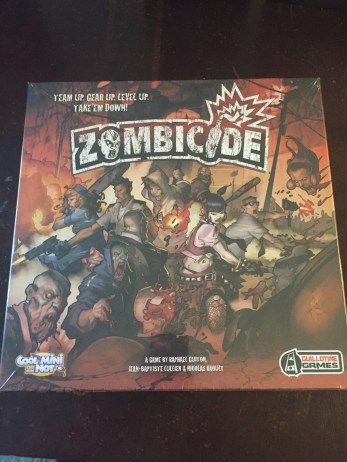
Zombiecide –The first game on the list is Zombiecide, which we’ve both heard great things about, but have never played personally. It is supposedly a pretty intense cooperative game with ten different levels with varying difficulty for each. I’m seriously looking forward to trying this game out- be on the lookout for a post on it sometime in the next few weeks!
The Resistance – I admittedly haven’t heard or seen much about this game before, but from what I can tell The Resistance is a tabletop party game based around a dystopian universe where a group is trying to overcome a corrupt government. I love dystopian novels and themes, so that immediately stands out to me. Apparently the game relies on deception and misleading the other players, so it could be a Sheriff of Nottingham-esque game style. I’ll be sure to see what it’s like soon enough!
One Night Ultimate Werewolf- Known to my girlfriend as “The  Werewolf Game”, I’ve been hearing good things about this for a while so it wasn’t surprising when I unwrapped it. A fast-paced game (only allowing for ten minutes of play), the game apparently has an app that links to it and the board game is an expansion of that. Everyone playing gets a specific role and then… something happens. I honestly don’t know yet, but I know it’s a lot of fun and I have a group of friends lining up to play!
Space Sheep- By far the best gift I got for my birthday this year, I saw this game at the  board game store Games Unlimited in Pittsburgh and was immediately drawn to it. Unfortunately I had already decided on the game I wanted to buy, so in order to avoid spending too much money I didn’t get it. Luckily enough Mary was there, and she was kind enough to buy the game for me. Now, for those of you with a keen eye, you will notice that this game is a parody of Star Wars… that involves Sheep. Here is a basic description of the game: “You are a Sheep. You are a Defender in the Strategic Sheep Command. You have trained all of your career for this moment in history. You know how to defeat Wolf – Ewe’s The Force…” Another cooperative game with some obvious wit and humor, I can already tell that I’m going to have a ton of fun trying this one out.
Once again, thanks so much to everyone who reached out for my Birthday. I can’t wait to try some of these games out, and rest assured I will be keeping my blog updated with my experiences along the way!
 t it’s impossible to choose just one. Other than the most basic expansion which bumps up the number of players from 4 to 6, you also have the Seafarer’s Expansion, then Cities and Knights, Traders and Barbarians, etc. Then on top of that there are alternate games that are separate from the original. As one of the premier board games of our generation, it’s no surprise that Settlers has found ways to grow on its success through expansions. If you haven’t tried any of the cool additions to the game, I definitely recommend them, especially the Seafarer’s expansion.
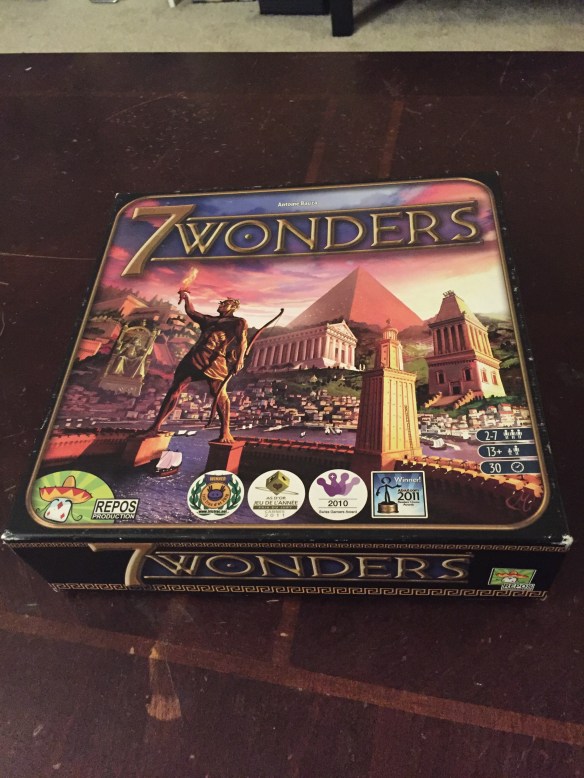
 he 7 Wonders: Cities expansion, Leaders adds additional regular cards and also brings in 42 historical leader cards, which you play at the beginning of each age. It also adds another Wonder so that 8 people can play rather than 7. Overall if you like 7 Wonders, the Leaders expansion does a great job of adding additional layers to it and also giving an extra person a chance to play.
 curses, each card has its own personality and is a great way to make you laugh. While the expansion packs don’t create any major changes to the
 ad with King of New York went two separate ways: either they would make the game exactly like the original, or they would completely abandon the style and make a completely unimpressive game instead. Luckily enough neither of those things happened, and the game King of New York found a way to take the same principles of King of Tokyo and expand/revise them to make something different, but with the same feel as the original. Having both games in your board game collection is definitely worthwhile.
 , so when I tried out Europe I was surprised at the subtle yet powerful differences between the two. It took some time to get used to the different geography, but the addition of ferries and tunnels plus the additional railroad markers made the game subtly more challenging. While this version might not be able to replace the original for me, it was a lot of fun and I plan on adding it to my collection soon.
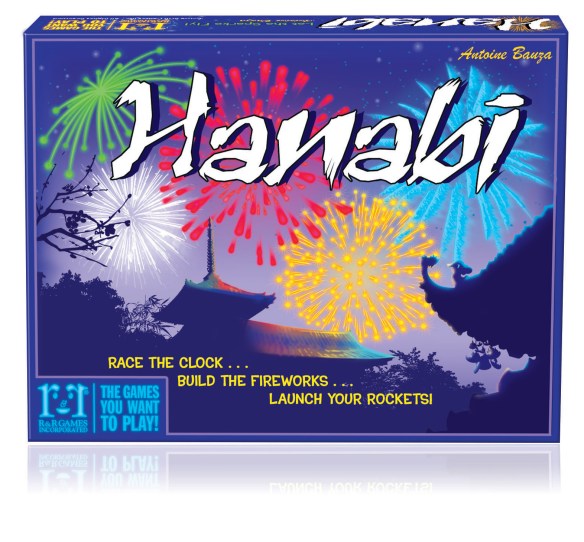 Cooperative board/card games have been becoming more popular over the past few years, with games such as Pandemic becoming more common for mass consumption. Cooperative games can have varying types and nuances to how they’re played, but the major theme is that rather than playing against each other, you play together against the game as a common enemy. Usually this involves completing some type of objective in order to win, while not meeting the objective will cause you to lose. Hanabi is a cooperative card game that actually goes by a different objective- work together to earn as many points as possible, with a point scale giving your group a grade at the end of the game. There aren’t any official winners or losers, but the competitive nature of the game is still tough to beat as you attempt to get a perfect score.
 olors of fireworks, all with numbered cards of 1-5, and the objective is to play all five of each color before the time runs out. The big catch in this game is that instead of players looking at their own cards, they face the cards outwards so that all players can see the cards except for the person holding them. Rather than simply telling a player which card to play, the other players have to provide hints about how many of a certain color or number is in the player’s hand. A player can also choose to play one of the cards in his/her hand; if they chose a card that chronologically matches what’s already been played, the card is added to the stack of the card’s color. Otherwise, the card is discarded. You also have a certain number of clues that you can give, which can be increased by a player intentionally discarding a card. The game ends when there are no more cards to use, and then points are tallied based on what cards were played by the end of the game.
 ct a player’s choice to play or discard cards. Memorization is also a key factor in the game, because you need to remember where each card is based on the clues you are given. The game is a lot of fun right off the bat as you are gathering information about your hand, and as more cards are played it is more difficult to play the cards in the correct order. There are also fewer of the higher value cards in the deck, so if you accidentally discard a 5 you can’t get a perfect score because there is only 5 card for each color available. All of this combines strategy combines into a game of subtle hints, careful decision making, and surprising amounts of tension whenever a card is played.


 they have extra foods or “contraband”. The added twist to this is that every round someone acts as “sheriff” who then can choose to inspect each person’s bag. If you were truthful about your goods then the Sheriff has to pay you, but if not the extra goods get confiscated and you have to pay the Sheriff. This means that you can try and smuggle contraband in for big point totals, or you can tell the truth and hope that the Sheriff tries to catch you. A number of other nuances in how you draw cards and what goods you choose to play add up to a very inventive and interesting game.
 an improv show where everyone put on different accents and asked silly questions to try and get a reaction from the group. This caused everyone to be more engaged in the game and the enthusiasm built up as we went. I feel like if you were in a group of more straight-laced people that wanted to play it normally it could be less exciting, though the strategy and gameplay still appeal to the average player. The game tends to drag at times if the Sheriff takes a long time to ask questions, so 5 players can take a while. Playing with 3 players, on the other hand, adds an extra round to the game so it doesn’t exactly shorten things. I recommend the game with 4 players if possible as the best middle ground option.
 the board game industry looks to be agreeing with me. Games of 3-5 or 4-6 players are becoming the norm in most cases, with plenty of games even exceeding those numbers. So when I was given my
  t all players and take the #1 spot. Board games are all about trying to win, so there’s going to be a high level of competition in any type of board game you play. Still, there’s something different about the competitive feel of a two person board game. You are essentially using your skills, wits, and strategy to defeat a single opponent; assuming the player is around the same skill level as you the intensity of that matchup can almost feel palpable.
 players, to ensure that the game stays fair to all parties playing. In addition, most games with larger groups of players are meant to allow for different scenarios for each party interacting with each other, so the complexity only increases. A two player game is streamlined because a designer can create the game without worrying about the 3+ player effect and can focus solely on the game mechanics of two people going head to head against each other.



 any of the rooms he/she wants and pays the Master Builder for the cost, then plays the rooms in his/her castle area. Each room has a different effect after it is played, which can get you more money, points, or bonus cards that have different effects. Play continues to the next player on the left, until it is the Master Builder’s turn. The Master Builder then can buy whatever rooms are left (if there are any) by paying the bank. Once the Master Builder finishes his/her turn, the person to the left becomes Master Builder for the next round. Once all of the Room Deck cards have been used up, the game is over and points are calculated.


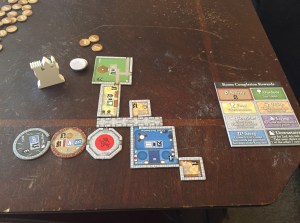 ch act as the starting point to your rooms. The first time you play the game, expect to take a very long time organizing and setting everything up (once you’ve played the game a few times it gets a lot faster). Because of how many pieces are involved, make sure that you have a lot of space available to play, especially if you have four players.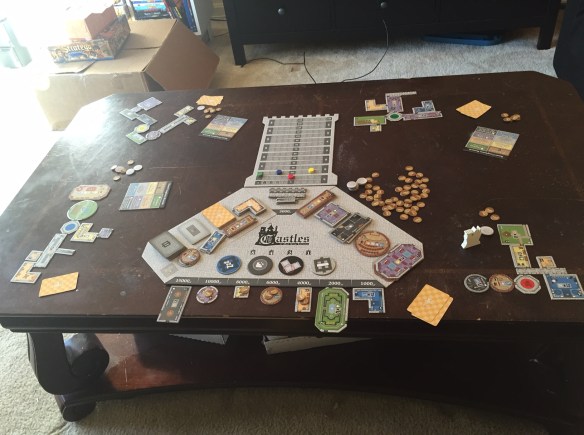

 tense amounts of strategy and some power-up cards sprinkled in for extra fun. The game starts off with everyone at 0 victory points and 10 health. The object of the game is to gain 20 victory points all while keeping your health from dropping to 0. You can victory points by rolling the dice, paying for victory point cards, and surviving inside Tokyo where you’re more likely to be attacked.
 t two additional dice rolls where you can choose to pick up and roll any of the dice you had thrown previously. After you’re done with your three rolls, you immediately “resolve the dice” by taking any necessary actions that come about from the dice you’v
 ou are a target for opponents to attack you. You can only stay in Tokyo when you have 5 health, so stockpiling health and energy is important. The cards bring an additional layer to it, and while the game can take some time getting the hang of it’s a lot less complicated than it originally looks. I particularly like the strategy of the dice roll, where you have to decide what to focus on during a particular turn. Choosing between victory points, health, energy, and hurting your opponents can be the difference between progress and defeat. Artistically the game is also very appealing, with six individual monsters that all look really cool (they somehow find a way to make mecha-bunny particularly impressive) and the cards each have a unique cartoon picture that makes the game engaging to the eye. I would have liked to see each monster have their own special ability to make your choice of character more important to the overall strategy, but even without that there are plenty of different paths you can take to claim the title of King.
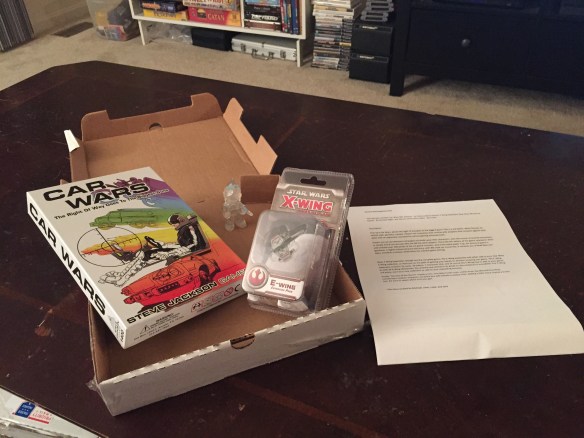 As mentioned in a previous post, I recently received two subscriptions from the company Tabletop Monthly with some cool board game goodies and nerdy accessories. I’ve been looking forward to diving into them for some time, and this week I’ve finally had some time to check them out in more detail. I focused on the “Hardcore” box set, with the more competitive and complex games as opposed to the “Family” subscription. Here are the items I received in this month’s box:




 The Boardwalk Games