For Christmas this past year, my lovely wife got me two new board games for our collection- Scythe and Concordia. We had a chance to play both before and wanted to make sure we had the games available to play any time. We have gotten a chance to play both games since and have had a great time playing each game- I highly recommend them both for people who like games like Settlers of Catan and other expansion/building games.
Since I have played both games recently, I thought it would be fun to do a comparison review and pit the games against each other as a way to kill two birds with one stone. I have set up 5 categories and given my thoughts for each, but first let me give quick summaries of the games:
Concordia-
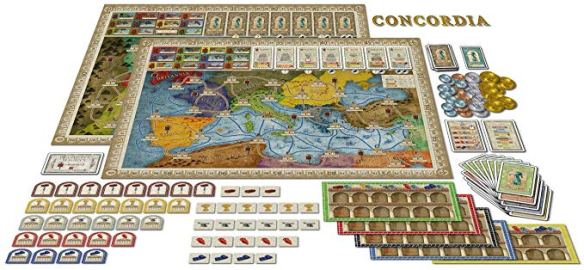
Published in 2013, Concordia is a game based on the expansion of the Roman Empire. Described as a peaceful strategy game, Concordia focuses around expanding your foothold across the Mediterranean Sea by acquiring resources, adding colonists, and expanding your deck of cards which ultimately count towards your total points for the game.
Scythe-
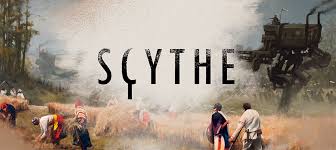
Set in an alternate reality with a 1920’s Steam Punk aesthetic, Scythe focuses on farming for resources, building Mechs and structures, enlisting recruits and fighting for territory on the board. Created in 2016, the engine-building feature of the game focuses on taking specific actions each turn and upgrading each type of action to be more efficient.
This obviously only scratches the surface of what these games are about, so let’s dive into the different review categories I created where we can go through the game in more detail.
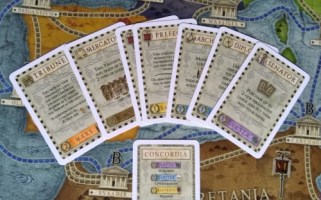
Game Quality/Artwork- The first thing I can say about each game is that they are both beautiful quality with great design all around. Both games match the theme they created quite well, with Concordia having a classic feel with bright colors across the map, and Scythe diving into a darker and more gritty look. Scythe has more opportunities to show off beautiful artwork, with it’s player and faction mats and action cards all having expansive drawings of different characters and events in this self-contained world. Concordia’s cards are more simple but match the theme well, feeling like scrolls with a different message included on each.



The one area I would say that both games were a bit lacking is the resource pieces: to me, this isn’t a major flaw, but it is something I noticed when playing both games. The resources you accumulate are represented by wooden pieces, and while the quality of the wood is good the shape and look of the resources themselves is a bit bland. The best example I can give is the Food resource in Scythe- to me it looks like a pot of gold which was somewhat confusing when I first played the game.
Note: I have the base version of each game, and after some research I saw that both games have enhanced versions with pieces that were better quality. I completed reviews based on the game versions that I had. Below is an example of the differences between Scythe’s pieces, with the base ones I have on the bottom:

WINNER: Scythe
Rules- One thing that is important to know about these games is that they are complex and have a large number of different rules and components. Each rule book is substantial and there is a lot of time dedicated to understanding the flow of the game and the different components. Game setup was straightforward for both games, with clear pictures in the rules showing how the board should be set up and step by step instructions for where everything goes.
Of the two games, I feel like Concordia had a slightly better set of rules that were easier to follow. This might be because the game mechanic is a bit more straightforward, but when I read the rules of Concordia I knew the purpose of the game more at the beginning and felt more comfortable with the gameplay as a whole. Scythe feels more like a game that you should play with friends who have already played- trying to learn everything without guidance can be very difficult. In particular, rules for resource collection and movement feel more complicated than normal games and take time to fully understand.
WINNER: Concordia
Gameplay- By far the most exciting thing about these games is that they both have completely unique game mechanics from any other games I have played- they both are innovative and provide a great new style of gameplay for my game collection. Each one has its strengths and it’s honestly tough to say which style is better.
Scythe focuses on a gameplay mechanic where you can choose 1 of 4 options on your Faction card, each with 2 separate playable options. This means that in total there are 8 actions you can play each turn, and you can choose to take 1 or 2 actions depending on your resources and situation during your turn. These actions include moving your pieces, trading and farming for resources, enlisting for special effects, upgrading your board to produce more and cost less, deploying powerful and versatile mechs, bolstering your power/gold/popularity, and building structures on the board. The interesting part of the gameplay is that you can’t take the same action twice in a row, so you have to strategize how to play each turn and think a few turns ahead, while adapting to other player’s actions on the board.


Concordia, meanwhile, uses a card-playing mechanic that gives each player their own personal deck with different abilities on each card. You start with your whole hand available to you, and each time you play a card and take that action, your hand gets a bit smaller. Eventually you can choose to take a turn to pick up all of your cards again, but waiting to do this until later is preferred because you get money bonuses the longer you take. Card actions available in the game include moving colonists, producing resources for players in a specific territory, gaining coins, trading resources, purchasing new cards to add to your deck, and copying the effects of an opponent’s previously played card.


WINNER: Tie
Scoring- Another complicated component to these games is how they are scored- both games have a scoring mechanic based on the resources and goals accumulated throughout the game, and both games have a twist on how these points are accumulated. Concordia’s scoring is based on the number and type of cards in your hand at the end of the game- the more cards of a particular type, the more points you get for that card’s effect (example, scoring points based on the number of territories you control). Scythe, meanwhile, has the same scoring for each player but the multiplier is based on how popular your character was based on their actions throughout the game. You can gain or lose popularity through a number of different actions, and at the end of the game you fall under three tiers of popularity, with the highest tier scoring you the most points.
The biggest issue I had with scoring is that it felt like I didn’t really understand HOW to score in order to win the first time I played the games. Both Concordia and Scythe feel like games where you need to play at least once or twice before you are able to grasp the full strategy of gameplay. If this were a bit clearer upfront, it would make people first playing the games more comfortable with their moves and decisions. I felt like of the two games, this was more the case in Scythe than Concordia, which is why I give Concordia a slight edge in this category.
WINNER: CONCORDIA
Play Time- If you don’t like board games with long play times, don’t play these games… especially your first time playing, these are definitely multi-hour games. The time goes by quickly for both, but it definitely is surprising how quickly you lose the day or night as you play.
Technically speaking, both Concordia (100 mins) and Scythe (90-115 mins) are clear about this upfront. However, I would mention that in both cases I have usually gone over the expected times for these games. This definitely feels like it is because I am still learning the rules or playing with people who are learning the rules, but it’s important to mention nonetheless.
WINNER: Tie
Overall- I know that I have brought up some criticisms in this review, but in reality the areas that I had issue with were minor inconveniences at most. In reality, both of these games are amazing and I plan to include them in my regular gaming rotation.
If I were to choose between these two games, my personal preference has to be Concordia. Scythe is brilliant and I enjoy the gameplay and feel, but Concordia feels like a more straightforward game to me while still being just as exciting. The gameplay is fast paced, with turns going quickly, and everyone is engaged during turns to see how people make their moves and how much more time they have. Overall, both games are worth your time and money, but if you were going to pick up only one from stores today then Concordia would be my recommendation.
WINNER: Concordia (4.5 out of 5)
CONSOLATION: Scythe (4 out of 5)


 dedicate your troops to an invasion is a crucial part of the game. You gain troops each turn, but after every turn the enemy has a chance at improving their ultimate weapon, so you can’t sit around and stockpile troops for too long. Sans Allies is also similar to the game
  trying to play the game. This meant that by the time I actually started playing the Limited War version of the game, I only had to check the rules a few times for my first play through. When I upgraded to Total War for my second play-through, I felt comfortable enough with the Limited War rules that I only checked the rules for Total War additions. Ultimately I’ve played through the game four times in total, and feel like I know pretty much everything I need to play the game moving forward.

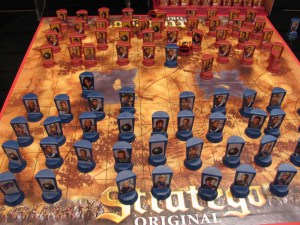 This game focuses more than any I know on pre-game setup. How you choose where to put your pieces effects the game almost more than your strategy for the game itself. Whether you put your flag as far away from the enemy troops as possible, try some form of misdirection, place the bombs near or far away from the flag, place your high powered players up front or use your weaker troops as shields, all of these ideas and more effect the game experience. Not only your choices, but your opponent’s choices and figuring out their strategy is crucial to success in this game. This doesn’t mean that the strategy stops when the game starts- memorizing your opponent’s pieces, understanding when sacrifices must be made, and adapting to new scenarios all become crucial as the game goes on. Being able to shift strategies and compensate for losses is one of the hardest things to do in a game, and Stratego takes this idea and runs with it.


 they have extra foods or “contraband”. The added twist to this is that every round someone acts as “sheriff” who then can choose to inspect each person’s bag. If you were truthful about your goods then the Sheriff has to pay you, but if not the extra goods get confiscated and you have to pay the Sheriff. This means that you can try and smuggle contraband in for big point totals, or you can tell the truth and hope that the Sheriff tries to catch you. A number of other nuances in how you draw cards and what goods you choose to play add up to a very inventive and interesting game.
 an improv show where everyone put on different accents and asked silly questions to try and get a reaction from the group. This caused everyone to be more engaged in the game and the enthusiasm built up as we went. I feel like if you were in a group of more straight-laced people that wanted to play it normally it could be less exciting, though the strategy and gameplay still appeal to the average player. The game tends to drag at times if the Sheriff takes a long time to ask questions, so 5 players can take a while. Playing with 3 players, on the other hand, adds an extra round to the game so it doesn’t exactly shorten things. I recommend the game with 4 players if possible as the best middle ground option.


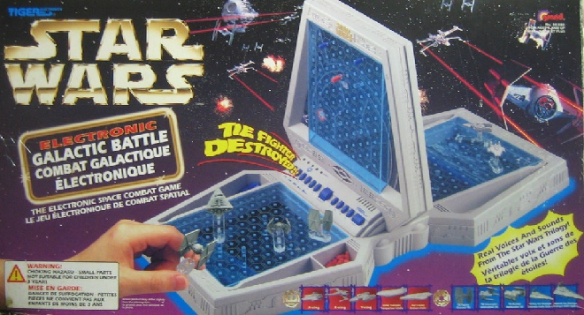
 get less and less until you lose all of your ships. If on any of your shots you hit a ship, your opponent must tell you where you hit and what ship it was. This speeds up the game significantly and also provides an added layer of strategy for when you’ve hit someone. Ultimately it’s a simple change, but it provides better results in my opinion compared to the traditional version. There is an element of luck to it because if you lose a ship early and have less shots to work with you are at a big disadvantage, but from the times I have played salvo I found that it stayed pretty even no matter how the first few games started solely due to the volume of opportunities to get a hit on your opponent.
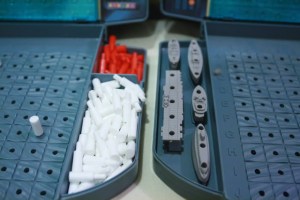 pencil available because you will need to write down as much information as possible each turn to help figure out which of your shots was a hit. For example, if on your first turn you choose A2, B7, H5, G9, and A10 as your five shots and your opponent tells you that you hit twice, that’s not a lot of information to go on. If you don’t keep a record of the hits and do some experimenting to figure out where those hits came from, it will be impossible for you to keep track of everything as the game progresses. This type of game can be a lot of fun if you play it right, but can also be very frustrating if you don’t keep organized and use your shots wisely.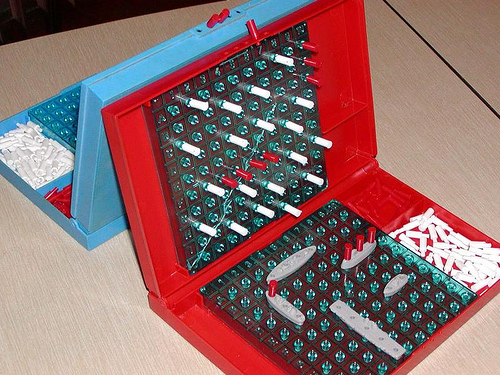


 any of the rooms he/she wants and pays the Master Builder for the cost, then plays the rooms in his/her castle area. Each room has a different effect after it is played, which can get you more money, points, or bonus cards that have different effects. Play continues to the next player on the left, until it is the Master Builder’s turn. The Master Builder then can buy whatever rooms are left (if there are any) by paying the bank. Once the Master Builder finishes his/her turn, the person to the left becomes Master Builder for the next round. Once all of the Room Deck cards have been used up, the game is over and points are calculated.


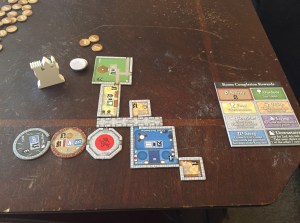 ch act as the starting point to your rooms. The first time you play the game, expect to take a very long time organizing and setting everything up (once you’ve played the game a few times it gets a lot faster). Because of how many pieces are involved, make sure that you have a lot of space available to play, especially if you have four players.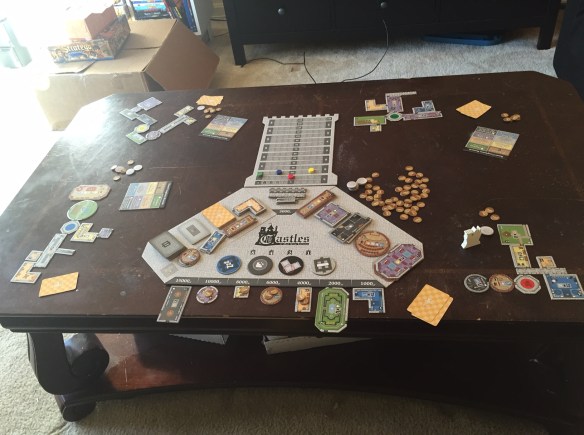

 tense amounts of strategy and some power-up cards sprinkled in for extra fun. The game starts off with everyone at 0 victory points and 10 health. The object of the game is to gain 20 victory points all while keeping your health from dropping to 0. You can victory points by rolling the dice, paying for victory point cards, and surviving inside Tokyo where you’re more likely to be attacked.
 t two additional dice rolls where you can choose to pick up and roll any of the dice you had thrown previously. After you’re done with your three rolls, you immediately “resolve the dice” by taking any necessary actions that come about from the dice you’v
 ou are a target for opponents to attack you. You can only stay in Tokyo when you have 5 health, so stockpiling health and energy is important. The cards bring an additional layer to it, and while the game can take some time getting the hang of it’s a lot less complicated than it originally looks. I particularly like the strategy of the dice roll, where you have to decide what to focus on during a particular turn. Choosing between victory points, health, energy, and hurting your opponents can be the difference between progress and defeat. Artistically the game is also very appealing, with six individual monsters that all look really cool (they somehow find a way to make mecha-bunny particularly impressive) and the cards each have a unique cartoon picture that makes the game engaging to the eye. I would have liked to see each monster have their own special ability to make your choice of character more important to the overall strategy, but even without that there are plenty of different paths you can take to claim the title of King.


 The Boardwalk Games