Top 10 Board Games as Last Minute Christmas Gifts

Christmas Logo

We’ve all been there at some point in our lives; it’s the week of Christmas, the holidays are in the air, and you’re trying not to panic because you still don’t have all of your Christmas gifts figured out. Whether it’s a Secret Santa gift you’re not sure about, or a close friend or family member who is particularly difficult to give gifts to, you’ll sometimes find yourself scrambling for something to wrap up and give out on the 25th. As someone who has a tendency to pick up gifts last-minute, I’ve gotten used to going to a store with a vague idea about what to buy somChristmas Shopping its over its doneeone but not knowing for sure until I actually see it. This year was the first year in a long time when most of my Christmas shopping was done well

beforehand, so I am on the outside looking in to the hectic last-minute rush, but I can honestly say I’ve felt your pain. So, in order to help with your struggles, I’ve compiled a list of some fun and simple board game gifts that you can find easily in stores this week!

Now obviously, board games are not the perfect gift for everybody. There are plenty of people out there who, for some reason, don’t enjoy board games as much as me. But for nieces and nephews who enjoy playing kids games or for older friends who like to host an occasional game night, there are some great options out there for you to find. Below I’ve listed my top ten Christmas gift games you can find in stores this week:

  • Apples to Apples– Apples to Apples is a great family and/or party game, and luckily enough it’s still around in stores pretty much everywhere you look. The game focuses around choosing the noun card that best fits a card picked by the judge. Fun and easy to play, it’s relatively cheap and popular among friends.
  • Clue– The mystery-based board game has goClue Logone through some changes since it was first created, but at its core it’s still the same game we all played as a kid. A popular game for youn
    ger audiences, I’ve used it for the occasional game night too so it’s not completely outdated for older groups. Make sure that the person you get this for doesn’t already have the game before you buy it for them!
  • Headbanz– The new version of an old game, Headbanz takes “Who headbanzAm I” and simplifies it for younger audiences. This game is fairly popular now and can be found in stores like Walmart, Target, and Toys R Us.
  • King of Tokyo– I found this game at Target when I bought it, and its popularity hasn’t waned since so it is definitely available in a number of different places. A topic of my most recent blog post, King of Tokyo is a dice rolling game that is perfect for all kinds of gamers.
  • Pandemic– Pandemic is a very popular cooperative game currently on the market, so it can be found pretty much anywhere you look. It is slightly more complicated than the average game, but is a good purchase for people who like to have friends over on a regular basis and would be interested in trying something new.
  • Quiddler– A less known game created by the designer of the card game Set, Quiddler is not the most common of Quiddlergames but I’ve seen it in department stores and most frequently in Toys R Us. The game revolves around spelling out words with letter cards and trying to use up as many
    cards in your hand as possible. Good for kids as it helps with critical thinking and mental acuity.
  • Qwirkle– The colorful mix and match game, Qwirkle focuses on matching shapes and colors to form groups and earn points. A good game for younger audiences, but also has appeal to older groups. The game is a bit older than some of the others so it might not be in every store, but it’s considered a staple of the board game industry and shouldn’t be too hard to find.Qwirkle
  • Settlers of Catan– It’s fairly self-explanatory as to why this game is on the list. Settlers is considered one of the most important board games in the industry’s growth and is a heck of a lot of fun to play. If you know someone that doesn’t have a copy of this game, go to any store and you’ll be able to buy it for them (along with many of its expansions).
  • Sorry!– A game that brings back memories for me, Sorry has been a Sorry!popular game for a while. Based on moving four pieces around the board, the trick is to avoid getting your pieces knocked off by other players as you race towards the finish. While the original is probably hard to track down, the newer version of the game is available in most stores.
  • Ticket to Ride– The ever-popular railroad expansion game is pretty pricey in comparison to others on this list, but is worth it if your friend or family member hasn’t played the game or doesn’t have a copy. The game focuses around building rail tracks from city to city, and can be found in all of the major stores without any difficulty.

This list isn’t all-exhaustive, and is more meant to prove the over-arching point that board games can be a good last minute gift for anyone on your list this year. Walking around a game section of a department store is a good way to find something that fits a person’s personality and offers a fun and interesting gift idea for a number of different audiences. To those of you who still have gifts to buy, good luck, and enjoy your holiday rush!

Board Game of the Week- King of Tokyo

IMG_2752


  • Game Title: King of Tokyo
  • Release Date: 2011
  • Number of Players: 2-6
  • Average Game Time: 30 minutes
  • Game Publisher: Iello
  • Website: iellogames.com/KingOfTokyo.html
  • Game Designer: Richard Garfield
  • Expansions/Alternates: Yes
  • Available in Stores: Yes

I once read an article that discussed the idea that a number of successful games are usually centered on themes that aren’t particularly interesting in real life. There is some truth to that: games like Settlers of Catan, Monopoly, etc. all have fairly straightforward concepts based around tasks or stories that are mundane and unimpressive outside of the board game realm. King of Tokyo takes this idea, smashes it into the ground, and sets it on fire while laughing gleefully.
The theme of King of Tokyo is this: you are a giant monster trying your best to infiltrate and destroy Tokyo all while undermining the other monsters trying to do the same thing, ultimately powering your way to the top and earning the title of the King of Tokyo.  Sounds simple enough right? In reality, the game is a predominately dice-rolling game with inIMG_2756tense amounts of strategy and some power-up cards sprinkled in for extra fun. The game starts off with everyone at 0 victory points and 10 health. The object of the game is to gain 20 victory points all while keeping your health from dropping to 0. You can victory points by rolling the dice, paying for victory point cards, and surviving inside Tokyo where you’re more likely to be attacked.

The dice rolling mechanic is very similar to Yahtzee- you have 6 custom dice which you roll all at one time, then geIMG_2755t two additional dice rolls where you can choose to pick up and roll any of the dice you had thrown previously. After you’re done with your three rolls, you immediately “resolve the dice” by taking any necessary actions that come about from the dice you’v
e rolled. Each die has 6 numbers/markings on it, and the goal of your dice rolls is to either match up the same number together to earn victory points, stockpile health/energy, or attack your opponents. After the dice have been resolved, you can buy any of the face-up cards to power up your monster and then use any effects from cards you want, and then your turn ends.

Ultimately this game is a lot of fun- there is a lot of strategy revolving around spending your time in or outside of Tokyo. Staying in Tokyo gets you victory points, but also means yKingOfTokyo_3Dboxou are a target for opponents to attack you. You can only stay in Tokyo when you have 5 health, so stockpiling health and energy is important. The cards bring an additional layer to it, and while the game can take some time getting the hang of it’s a lot less complicated than it originally looks. I particularly like the strategy of the dice roll, where you have to decide what to focus on during a particular turn. Choosing between victory points, health, energy, and hurting your opponents can be the difference between progress and defeat. Artistically the game is also very appealing, with six individual monsters that all look really cool (they somehow find a way to make mecha-bunny particularly impressive) and the cards each have a unique cartoon picture that makes the game engaging to the eye. I would have liked to see each monster have their own special ability to make your choice of character more important to the overall strategy, but even without that there are plenty of different paths you can take to claim the title of King.
IMG_2754

This game is suited for people of all ages and groups of all sizes- Iello really knocked it out of the park on this one. Plus, giant fictional monsters fighting each other in a large populated city should always be enjoyed no matter what the context.

Jack’s Rating: 4.5/5 stars

Tabletop Monthly, Hardcore Subscription

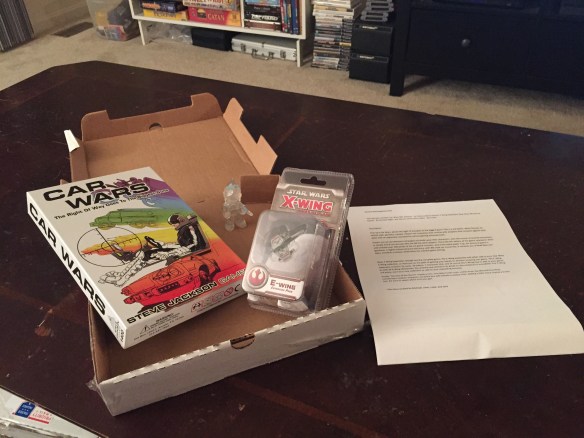
IMG_2745As mentioned in a previous post, I recently received two subscriptions from the company Tabletop Monthly with some cool board game goodies and nerdy accessories. I’ve been looking forward to diving into them for some time, and this week I’ve finally had some time to check them out in more detail. I focused on the “Hardcore” box set, with the more competitive and complex games as opposed to the “Family” subscription. Here are the items I received in this month’s box:

Board Game, Car Wars- A Steve Jackson Games creation based on gladiator style automobile combat, Car Wars is highly focused on dice rolling and maneuvering vehicles around a track. The game is highly customizable and complex, with a comprehensive rulebook and a number of different types of vehicles and weapons. Games can be played either in a single duel format or a multi-session campaign style, depending on preference. Average price is around $16, so it is a majority of the value in this box set.IMG_2746

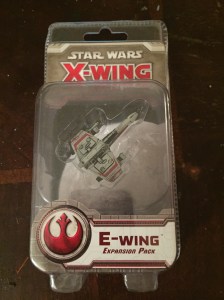
Expansion Pack, Star Wars E-Wing– One of the more popular competitive games on the market, the Star Wars Miniatures game is a war game with a number of expansions available. I currently don’t own the core game for this expansion, but it is on my wish list so this is a good opportunity to start my collection of miniatures. The E-Wing miniature is worth about $10 and is helpful add-on to what looks like a cool game.

IMG_2747

Heroes of the Storm mystery mini- This was the one extra in the box I didn’t have any information on, but it looks like Heroes of the Storm is a miniatures set created by Blizzard Gear which has a number of different cute minis for collection. I got the Clear Variant mini character Nova, from the StarCraft set. A cute little addition as part of another “collect them all” series, I personally won’t have a strong urge to collect more but still think it’s pretty cool. Each miniature is part of a random draw, and cost about $10 per mini.

So now that I’ve given a rundown of the items in the box, here are some of my thoughts on the box and its contents:

  • The contents of the box are worth close to what you’d pay for them normally, with a slight discount overall (shipping is not included in this pricing breakdown). Ultimately you’re not saving an insane amount of money with this subscription, but they do provide you with a fairly good deal. I’m sure the totals will vary slightly from month to month, but it looks like the boxes will be worth the $30 subscription for the items you receive monthly.
  • The mystery of the box is part of the charm of the subscription, but you might have to be prepared for getting one or two items here and there that you simply won’t use. Still, of the 3 items I received I plan on using two of them quite regularly, so there’s definite value there. There is also a chance for receiving something that you already have of course- this is more likely to occur with people who have large gaming collections, but it could happen to the casual gamer as well depending on the situation.
  • I would definitely recommend finding the right box for you early, because not everyone would want to play the hardcore games and not everyone would want to play the family games. There will be some people who would like the idea of getting both boxes, and that is certainly an option. However, you would be paying $60 a month so depending on how much you budget out for board games a month you may have to pick your preference.

Overall I was quite happy with the mystery box I received for “Hardcore” games- I will be reviewing the “Family” subscription later this week, and am hoping to have the same results!

Christmas: A Time for Family (and board games)

Christmas Trees

If I were to choose a favorite holiday, I would probably say Christmas gets the #1 spot in my book. I have so many amazing memories surrounding Christmas; traveling down to Florida with my family, spending time with my relatives from my mom’s side of the family, and calling my dad’s extended family in England to wish them all a Happy Christmas… The gifts were obviously a big part of my youth, but now looking back it’s really all about the family to me. I’m blessed to have extended families on both sides that get along and want to see each other, rather than the stereotypical dread that revolves around some holiday gatherings. Are these Christmas vacations I remember perfect? Of course not. Cousins bicker, Uncles and Aunts have to work late hours, people get sick (usually me for some reason…) and the magic of Christmas seems slightly less magical with the passing of my Grandma this past winter. But still, leading up to December 20th when I drive myself up to Pennsylvania (we switched venues a few years ago from sunny Jacksonville FL to snowy Gibsonia PA) I can’t help but smile at the idea of seeing my family soon.

One of the highlights about the family vacations is seeing my cousins on
my mom’s side: my sister and I are the oldest (she’s two years older than me), and then I have two cousins in college (Betsy and Lauren) and two in High School (Stephanie and Billy). Since all of my cousins are younger than me, watching them grow up can be a very strange feeling. When my mom told me that Betsy had started driving I remember looking at her and telling her that I didn’t believe her. The days when we were all under 5 feet tall couldn’t have been that long ago right? Still, it’s great to see that they are all growing up to be smart, talented, and moskeep-calm-its-just-a-family-reuniont importantly genuinely kind and good people.  Sure, we have our fights, and I know that sometimes I can be inattentive as a cousin, but there are so many great memories it’s like the bad ones don’t even exist in my mind. OK, so now that I’ve gotten the mushy stuff out of the way, I bet you’re thinking “that’s great Jack, but why are you talking about all of this on a blog about board games?” I’m glad you asked random reader, because this article has one very specific purpose: to show you how tabletop games can make Christmas better.

As I have mentioned in previous posts, I play a lot of video games in my spare time. This was especially the case when I was in High School; any chance I got to play video games I would take. The problem was that I was also a very active High Schooler, so whether I was playing in the band, singing in the choir, or hitting serves on the tennis court, I was always busy after school and didn’t have much time when I got home what with homework and that whole “sleeping” thing. So my brilliant solution to this issue was to take my Xbox 360 with me to Florida! It’s vacation, I’ll have tons of time to play the new games I got right? Well, technically yes, but it had a bit of a backlash when it came to my cousins. Now, I’d like to preface this by saying that I wasn’t intentionally trying to ignore my relatives; the issue is mostly revolving around the fact that kids change when they get older. When they were younger, my cousins all really enjoyed watching me play games like Luigi’s Mansion or Pokémon Snap (bringing back N64 game references… I must be getting old). But as we all got older, the types of games I liked changed to one-player adventure games like Prince of Persia or Assassin’s Creed, and my cousins started to become bored with the idea of sitting around a room watching me play a game they couldn’t enjoy themselves. So slowly but surely, things got more frustrating for them (while I remained oblivious) until one cousin said to me “all you do is play video games when you’re here, so what’s the point of you even coming?” And suddenly I realized that what I wanted to do when I was on vacation wasn’t the same as what my cousins wanted to do. I left Florida that year feeling guilty, but also not knowing what would happen when we returned the next year. Should I stop playing video games around the holidays? Is it alright to get a little bit of time to myself to play, or is that selfish? Luckily enough, the next year ended up being one of the better ones, and paved the way for a new tradition on Christmas.

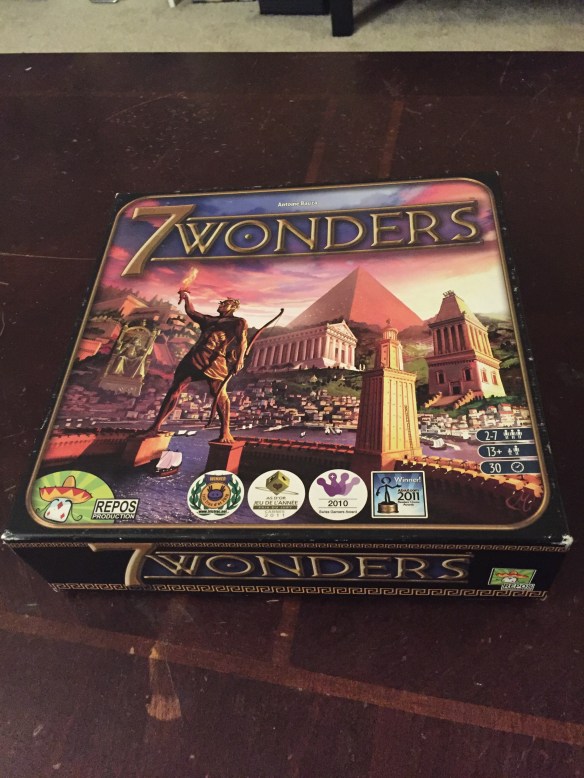
Christmas next year started off a similar way- I pulled out the consoles I had brought with me and my cousins rolled their eyes. We had dinner, we chatted, and things were fine but there was a feeling that it could go south if I moved towards my Grandpa’s den, where my video games were all set up. And then my sister made a recommendation that I will always appreciate: why don’t we play a board game after dinner? It just so happens that one of Katie’s new gifts was 7 Wonders, and she wanted to teach us to play.

Sure enough, we all sat down and labored through the tutorial and finally started to get the hang of things in our first play through. And suddenly, it was as if last year had never happened. I can’t stress enough that games are great at bringing people together- you can focus on a fun activity, but also have time to catch up, joke around, and all in all have a great time. 7 Wonders has become a favorite of ours to play, but we’ve also brought along games like Clue, or Settlers of Catan, or the Lego creation game called Creationary. Not all games are a hit (a two hour game of Settlers of Catan has spoiled it for my cousins somewhat) but no matter what happens with the game we enjoy ourselves. We don’t spend all vacation playing board games of course: we go outside and throw a football, build puzzles, watch TV, and yes I do get some video game time every once in a while. But the games are always a fun part of what we do. I’m looking forward to seeing what new games we play this year, but more than that I’m looking forward to spending time with my family.

So if you spend time with your family this Christmas, I recommend you find something that connects you in the same way board games have connected my family. Ultimately, if you look past the gifts and the food, Christmas is a time for family, and for me that time is something I get to enjoy with some slight help from board games along the way.

Board Game of the Week- 7 Wonders

image1

  • Game Title: 7 Wonders
  • Release Date: 2010
  • Number of Players: 2-7
  • Average Game Time: 20-30 minutes
  • Game Publisher: Repos Production
  • Website: http://rprod.com/index.php?page=description-22
  • Game Designer: Antoine Bauza
  • Expansions/Alternates: Yes
  • Available in Stores: Yes

Some board games have a simple style that you learn quickly and then play, without any additional strategy involved. In contrast, there are games that take a lot longer to learn and even once you’ve learned, there is still an opportunity to learn and improve because of the strategy involved in mastering the game. 7 Wonders definitely falls into the latter type of game. I’ve tried to explain the game multiple times to new players and have always received looks of confusion and frustration right away. However, once they start to play and get the experience of “learning by doing”, it all starts to make sense.

I’m not going to go into all of the details of how to play the game (I would be writing a 10 page essay), but the basic premise and rules I can try to explain. To start, each player randomly chooses an individual board with one of the 7 wonders of the world: Babylon, Gizah, Rhodes, Alexandria, Halikarnossos, Olympia, and Ephesos. These boards each have different resources that they provide as well as different “wonders” that have additional benefits as the game goes on. Gameplay is completed through a series of cards that are distributed evenly through three “ages”. There are multiple different types of cards, such as resource cards, science cards, army cards, and more. Using the cards that fit with your Wonder and your overall strategy is the key to win.

To play the game, each player takes his/her cards, chooses a card to play, and plays it at the same time as the other players. The hands are then given to the player directly to the left, which becomes the hand used to play the next card. This process continues until each player has two cards left, when the players each choose one card to play then discard the other. Finally to end the age, each player goes to war with the players directly to their left and right, providing points to whomever has the most army cards. The second age follows the same process except the players hand their cards off to the right, and then the third age switches back to the left. After all three ages are completed, points are calculated based on the cards played, along with war points and points from Wonders. The player with the most total points from all of these factors wins.image2

Reading my explanation of how the game works probably doesn’t do it justice, but I hope that it gets across the vast number of strategies and cards that are involved in every game. That’s the biggest benefit of 7 Wonders by far, is that you can use countless different strategies to succeed. You can build up armies, improve your sciences, create more culture through monuments, or build your wonders to gain points, and any mix or combination and more will lead to your total score. Another advantage of the game is that once you get the hang of it, it isn’t a particularly long game. You can feasibly play the game 3 or 4 times within a two hour period, which gives you the chance to try out new Wonders and strategies and keep things fresh.

Ultimately the downsides of the game are focused around the steep learning curve. I’ve had friends who tried to get into the game but didn’t have the patience to learn the rules and ended up losing interest before they got the hang of it. It’s also a game where you will be constantly checking the rulebook because the card descriptions are extremely vague. I’ve played the game dozens of times and still don’t remember what certain cards or wonders do. Finally, the game is fun with any number of players but when you get to 5+ it gets harder to keep your area organized because so much space is taken up with your board, cards, coins, etc.

While the game may not be for everyone, 7 Wonders is a great game to play in the right setting. It’s also a good game to have as a staple in your game nights. I also recommend taking a look at the expansions out there, because once you expert the game it’s fun to add in additional layers to it.

Jack’s Rating: 3/5 stars

Tabletop Monthly Subscription


One of the most frustrating parts about board games for me is purchasing the games. I don’t mind spending money on a good game of course, but I have a very long list of board games that I want to play at some point and games can be expensive. It’s hard to justify buying more than a few games a month, especially around Christmas time when you’re buying gifts for your friends and loved ones. One of these days I hope to find a way to rent board games for a limited time (if someone ends up creating this, I want in!), but until then it’s either playing your friend’s games or buying them yourself. With all that being said, I was recently contacted by an up-and-coming family business that could potential make buying games a lot more interesting.

The company is called Tabletop Monthly, and it works just like it sounds. You subscribe to their service for $30 a month and once a month you receive board games, card games, and accessories for your enjoyment. Whatever games you receive are your forever, and you never know what games you will be receiving on any given month. There are two different types of boxes, one for “hardcore” games and one including “family” games. The hardcore games are more technical and competitive, whereas the family games lean towards simpler themes that you can pick up easily and play with anyone. This isn’t the first board game subscription service in the market, but it’s a good price and the different types of subscriptions allow any type of tabletop gamer to enjoy the games they deliver.

The company is owned by a family of gaming enthusiasts (who own a pizzeria as their main job) and they were kind enough to give me two sample boxes to try out and review. Initial impressions are good- I received one game and two miniatures in the hardcore box and three travel sized games in the family pack. One of the most important things to mention about the games I received is that I didn’t own any of them; in fact, I had heard of some but there were others I didn’t know existed until I opened the box!

I haven’t gotten a chance to play any of the games yet, but I plan on doing so soon and writing up an in-depth review of everything I received. Until then, if you’re interested in learning more about Tabletop Monthly you can find them at tabletop.cratejoy.com or on Twitter @tabletopmonthly. They’re currently doing a promotion where if you provide them with your E-mail address, you’re entered into a drawing to receive a lifetime subscription for free!

That’s it on Tabletop Monthly for now. Be on the lookout for more posts soon with additional details about the new games I got!

Real Neat Blog Award Nomination

real-neat-blog-award

I recently was nominated by The Geek Couple for the Real Neat blog award. Thanks for the nomination guys! For any readers who haven’t yet, please check out their awesome blog! The Geek Couple asked me some pretty tough questions, so I hope I can do them justice in this post. Here are my answers:

  1. If you could meet any fictional character, who would it be and why? Starting off with an almost impossible question for me to answer… as a lover of movies, TV, comic books, regular books, and video games, the number of fictional characters I adore and would love to meet is practically unlimited. I think for this question I’ll have to go with my favorite superhero, Green Lantern, specifically Hal Jordan. Not the normal answer for a favorite superhero I know, but the Lantern Corps has always fascinated me and Hal Jordan was the very first human to take up the mantle so he holds a special place in my heart. His willpower, determination, and kindness make him a good person, and his wit and dry humor match mine very well so the conversation wouldn’t get dull after I got over the “holy crap I’m meeting a superhero” moment.
  2. What’s the most memorable place you’ve ever traveled too? I went to Scotland with my family when I was in High School. I remember stepping off of the airplane and feeling a cool breeze, and taking in a deep breath of the cleanest air I’ve ever breathed. The views were amazing, and while we didn’t go to any fancy events or places we took walks and spent time outdoors as a family, and it felt great.
  3. What’s your favorite board/card/video game? Another tough question, I’m going to give one answer for each category. My favorite board game right now has to be Ticket to Ride, though Settlers of Catan is a close second. As for card games, I would say Cards Against Humanity and Exploding Kittens are tied for the top spot. Finally there’s video games- Witcher 3 is my favorite “new” game while Super Smash Bros. would be my favorite “classic” game. I know I was supposed to pick one and ended up choosing 6, but that’s what happens when you’re a fan of all things nerdy.
  4. Describe your perfect weekend? It would start off with drinks and board games with good friends on Friday, followed by a Saturday out with my girlfriend doing any number of different things (movies, skiing, museums, laser tag, the list goes on). Then on Sunday I would get up and go to church, come home after and watch football all day. Doesn’t get any better than that.
  5. Why did you want to start blogging in the first place? I think the main reason I started blogging is because I wanted a creative outlet for myself. I’ve always had a passion for board games, even so much that I’ve considered opening up a board game shop at some point in my life. I talked with some friends and family about it and decided that I needed to immerse myself in the world before I made a leap like that. I’ve always enjoyed writing, and while I wasn’t sure what it would be like to write a blog I have enjoyed it immensely and hope to continue it for many years to come.

Now it’s my chance to nominate some other cool blogs for the Real Neat Blog award. There are so many great blogs out there and great writers that I enjoy, but here are the 5 that stand out to me (in no particular order):

If you run one of these blogs and are interested in participating, write up a post and answer the following questions for me:

  1. What is your favorite book series?
  2. If you could learn one new skill in life, what would it be and why?
  3. Have you ever considered writing a blog about something other than your usual topics? If so, what about?
  4. What is your favorite type of game, between board game/card game/video game?
  5. Who is your favorite superhero and why?

I look forward to reading your answers!


Monopoly Rules- the Good, the Bad, and the Ugly

Monopoly-rules

As I said in my recent blog post In Defense of Monopoly, one of the major advantages to the game Monopoly is its malleability. There are a number of “house rules” that are used as if they are a part of the game, while other rules are ignored completely. Sometimes it seems like everywhere you look, a different set of rules is being used when playing this classic game. A lot of the rules that are added (or scrapped) add to the fun of the game, but there are also rules that can directly result in the game being drawn-out and less enjoyable overall. After having some experience playing numerous different types of Monopoly boards and implementing all sorts of different rules, I have come up with some observations on the best way to ensure your Monopoly game is played with rules that will enhance the game rather than drag it down. I’ve split the types of rules up into three sections: official rules, house rules, and new rule suggestions.

Official Rules

1) Auctioning Property- The official rules in the Monopoly rulebook state that, “Whenever you land on an unowned property you may buy that property from the Bank at its printed price… If you do not wish to buy the property, the Bank sells it at auction to the highest bidder. The high bidder pays the Bank the amount of the bid in cash and receives the Title Deed card for that property. Any player, including the one who declined the option to buy it at the printed price, may bid. Bidding may start at any time.”  I can’t tell you how often this rule gets overlooked or ignored when I’m playing with friends, but truth be told this is an extremely important rule to utilize if you want your game to start off fast. Auctions aren’t necessary to play the game, but they do drive it forward at a faster pace and they also require a significant amount of strategy. Auctions are a good way to keep the game fair too- someone could have few properties but a large amount of money, and the ability to auction will help them get back in the game. Ultimately the start of a game of Monopoly without auctioning is fairly dull and can allow a player to pull ahead early, so the ability to auction helps balance the scales and keep things moving.

2) Mortgages- Mortgaging a property can seem like a pain, but it is a good way to ensure that you are not eliminated from a game. One of the paramount strategies of Monopoly is to keep your monopolies intact to increase your odds of a big payout. But if you land on someone’s property and have to pay up, it’s difficult to keep your houses/hotels on the board in order to do some real damage. The ability to mortgage should be used when possible, but should also not be taken lightly. I’ve seen people disregard the 10% interest rule when mortgaging; ultimately that seems like a good way to keep players who got hit hard in the game, but it also gives people an opportunity to mortgage cards early for short term gains without penalties when they want to un-mortgage the property. This is one of those rules you should keep intact.

3) Buying and selling houses/hotels- As I’ve said before, building on monopolies is a big part of success in a game. However, there should also be a cost if you try to expand too quickly and it backfires. The official rules state that if you have to sell back a house or hotel, you only get half of the money you originally paid for it. This rule is extremely important to ensure that players do not spend all of their money on hotels at once- a gradual pace for hotel building is a good way to keep things more evenly matched. Selling houses and hotels should be considered a last resort, and being able to get your full money back diminishes the risks of investing in your monopolies.

House Rules

1) Free Parking Money- This is the most wildly-contested rule out there; is there supposed to be money in free parking? If so, how much? Do you add money from income taxes to the free parking “pot”? Ultimately this iFree Parkings not an official rule to Monopoly, but it’s an extremely popular one and is used in a variety of different ways. I personally believe that this is a good rule because it has the ability to provide alittle extra respite to players down on their luck. The ideal scenario in my opinion is to add $500 to the free parking pot at the beginning of the game, and then once somebody
lands on it, you refill it by that same amount. No income tax or Chance/Community chest money should go into the pot, so that it acts solely as some additional funds rather than a complete game changer.

2) Landing on Go- This rule revolves around the idea of “Passing” go and collecting $200. This is what the board and the rules say, but what happens if you land on Go? Officially, nothing would happen, because your piece has to pass the space before you receive the money. However, there is a house rule some people use to provide an extra reward for landing on Go. In this scenario, you actually receive $400 if you land on go as opposed to pass it. I have no issue with this rule, but I do recommend setting it up with a slight addendum; when you land on Go you receive $200, then get the extra $200 on the next turn after you’ve passed the space. That way a player isn’t automatically flush with $400 cash in one turn, but still gets the extra award for landing on Go.

3) Trading properties- Trading properties is an essential part of Monopoly. The ability to trade for monopolies is an important way to ensure that you can advance the game, but it is not officially stated in the original rules that trades are allowed. While trading is necessary to create a more fun game, it also has the ability to cause skewed games from lopsided trades. Because of this, I have a slight alteration on the standard trading process that I recommend. Rather than trading at any point in the game, a player can only propose trades on their turn. Trades are completed before any dice are rolled, and if the trade created a Monopoly that player can’t add houses or hotels to the new monopoly until his/her next turn. Finally, if there are more than 4 players playing the game and at least 3 people consider the trade to be unfair, they can reject it (this is not something I’ve ever practiced myself, but I think it would be more likely to ensure a single player doesn’t run away with the game).

New Rule Suggestions

1) Jail- I can’t even describe how infuriating it is to watch someone get carted off to jail (metaphorically of course) right before landing in my monopoly area, and then have myself land on their property and lose everything while they sit pretty for 3 turns. Because of this, I recommend a rule variant that isn’t used by many but should be a positive change to the game. If a player is put into jail, they are then officially unable to collect payment from a player landing on their properties, and also cannot buy hoMonopoly Jailuses or hotels until they are released. The player can buy out of jail at any time in the 3 turn stint, but ultimately if the player stays in jail no players landing on his/her properties will have to pay the fees associated. This will cause players to want to leave jail earlier, which will speed up the game and make sure that each player has greater chances of landing on an opponent’s space.

2) Starting Game, Property Buying Delay- This is a rule I’ve played with my friends in the past to varying success. The concept is that you have to pass all the way around the board once before you are allowed to buy any properties. The rule is supposed to promote fairness since generally speaking the player who goes first in traditional Monopoly has a higher chance of winning properties. However, if a player lands in jail or rolls poorly during the first few turns, he/she becomes crippled by the rule and it makes it that much harder to get back into it. Ultimately there are pros and cons to this rule, so there’s no harm in trying it yourself but I would not recommend it as a must-rule to improve the game.

Ultimately these rules are about creating the best experience you can when playing Monopoly. This means that if you don’t like one of the rules, you shouldn’t use it, and instead use whatever rules you find to be the most fun. There are also rule variants out there for intentionally shortened games, so if time is the major concern there are options for fixing that. If you have any other cool ideas (I know that Past Go’s writer Geoffrey Greer was looking into a variant that could break apart an opponent’s monopolies mid-game) then send me a comment about it!

Board Game of the Week- NFL 1998 Monopoly

IMG_2712Blog #14- Board Game of the Week- NFL 1998 Monopoly

  • Game Title: Monopoly: NFL Official (1998)
  • Release Date: 1998
  • Number of Players: 2-8
  • Average Game Time: 60 Minutes
  • Game Publisher: Parker Brothers
  • Website: http://monopoly.wikia.com/wiki/NFL_Official_Limited_Collector’s_Edition
  • Game Designer: Uncredited
  • Expansions/Alternates: None (unless you count all other Monopoly games, ever)
  • Available in Stores: No (available online)

For those of you who don’t know much about me, I am a big NFL fan. On any given Sunday during football season odds are astronomically high that I’m spending the day sitting on the couch watching NFL Redzone all day and checking my fantasy football scores. So when I say that my favorite type of Monopoly board is based on the NFL, that fact should not be surprising to you. What might be surprising is the fact that the game I am playing is from 1998. This is actually the very first non-traditional Monopoly board that I played, and it was the beginning of a growing collection of different types of Monopoly boards.

The similarities of NFL Collector’s Edition Monopoly are fairly obvious- the number of properties, players, and board are all the same setup as a regular Monopoly board. You still have Jail and Free Parking and you still pass go and collect $200. The important rules and regulations of the game all mirror the Monopoly everyone has grown up playing. So what’s the difference? It’s all in the aesthetics. The properties, rather than being locations, are NFL teams. All 31 NFL teams are represented either as their own property, or in groups of teams listed as the “railroads”. Rather than houses and hotels, you buy sections and stadiums. Instead of Chance and Community Chest, the card selections are from AFC and NFC to represent the NFL’s two divisions. Even the dice and tokens are different, with custom football-shaped dice and NFL themed silver tokens. The gameplay is almost identical to your average game, yet the feel is totally different because of the different look.

IMG_2711

I think my favorite part of this game is about the nostalgia. For any football fans over the age of 25, you will love seeing where all of the NFL teams are on the board. A few prime examples: The Jaguars are the 5th most expensive team on the board, and the Cardinals and Colts are the two least expensive. It’s just wild to look back at how different the NFL was only 17 years ago- there weren’t even 32 teams at the time! But nostalgia isn’t the only fun aspect of the game- Parker Brothers took this theme and made the most of it, and it makes it a lot of fun. The NFC and AFC cards are all football-related events, with pictures of the Monopoly Man in football gear being traded or fighting off injury. On top of all that, the game runs like standard Monopoly, so the different theme doesn’t affect gameplay.

Downsides are the normal downsides that come with Monopoly- longer game times, slower pace of play, and a possibility of players to run away with the game if luck is on their side. Ultimately my enjoyment of Monopoly is higher than most, so I understand that I do have a bit of a bias here. Still, the NFL edition of this game is just as good as the standard version of Monopoly, so feel free to take that however you would like. It’s a great game to add to the collection for any sports fan looking for a reminder of the good ‘ol days.

Jack’s Rating: 4/5 stars

In Defense of Monopoly

Monopoly Boards

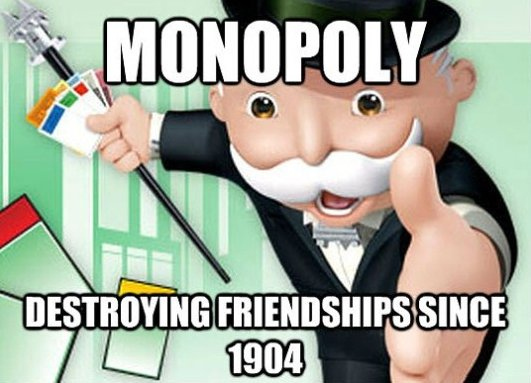
I can’t tell you how many people I know that have a burning hatred towards Monopoly. It honestly surprises me that whenever someone sees my Monopoly board collection for the first time, they almost always talk about what an annoying/long/tiresome game it is. Sure, the average game of Monopoly can definitely take longer than other board games, but it’s no longer than Risk, Axis and Allies, or even Munchkin. And yet of all of the games that are on the market today, Monopoly is one of the most successful and long-lasting but also one of the most criticized. Any time I browse the Internet I randomly see memes or pictures like this sprinkled around:

monopoly ruining friendships

Personally, I’ve been a fan of the game Monopoly ever since I was young. I played it with friends through high school and still play it with my roommates every once in a while when we’re all in the mood. I have 12 different Monopoly boards and have fond memories of playing all of them at different times in my life. So in honor of one of the most iconic games created in the 20th century, I’m going to explain why I believe that Monopoly is actually a great game to play and should always be a staple of your board game nights. Here are my top 5 reasons why Monopoly should be celebrated in the board game industry:

1) Easy to learn, but hard to master

One thing that can always be frustrating about board games is the time it takes to pick up on how to play. A game that is easy to learn quickly is one that will grab your attention faster and will be more likely to keep you playing, provided it stays interesting over time. When you look at Monopoly at first it may seem more complicated, but the concept is straightforward enough to pick up fairly quickly and not be far behind people who have played the game before. On the flipside of that, the game is actually surprisingly tough to master in certain ways. Sure, everyone can play the game without much strategy involved, but when you get into a group of competitors you start analyzing every move you make, every trade you attempt, every time you buy a hotel, to the point where you have to be very knowledgeable about the game itself to be an expert at it. The game allows for novices to play and have fun, but can also bring a significant amount of challenge to it when the setting is right.

2) Quick changes to the “Leader Board”

Sometimes when you play a board game, a single person will start off strong and you just won’t be able to keep up. That’s not the case when you play Monopoly- in fact, lead changes are fairly frequent once you get into the later stages of the game. Generally speaking there is a point of Monopoly where everyone has one or two monopolies and is working to build houses/hotels on them. One bad move or bad roll during this time can completely change the dynamic of the game. Someone with houses littered across the board will suddenly have to sell them all back, and maybe even mortgage or trade properties to stay afloat. Fortune can change in the blink of an eye, and while it’s true that if a player gets very unlucky and has to mortgage most of their properties he/she will most likely be stuck in that hole, the truth is that there is a lot more variety in the game standings than people give it credit for.

3) Ability to make custom rules

If you were to take out any board game you’ve played before right now, odds are high that you would know a majority of the rules of said game and you would stick to them no matter what. That’s not the case with Monopoly. Monopoly is a game with more “house-rules” than I’ve ever seen. Maybe it’s because of how long its in production, but it seems like every time I play with different people I have to be prepared for a different set of rules. Rules like free parking, mortgaging, auctioning spaces, landing on Go, and many more are all up for debate, and so before the game is started you may have to suddenly adjust to the new rules that your friends/family have put in place.

4) Teaches kids basic business lessons

I remember playing Monopoly Junior when I was a kid, and spending a lot of time counting up my money and making sure I had enough to buy a hotel or a new property. Learning the value of trading,monopoly money understanding basic math and business, and figuring out when and when not to invest are just a few of the business skills you learn from playing Monopoly. Obviously in no way does Monopoly dir
ectly translate to the business world (if it did I would be rich by now) but you can’t discount its uses in teaching youth the value of fake pink colored money.

5) Different types of boards/games

When a game has been around for over 100 years, odds are high that gaming publishers will take advantage of its popularity by creating different versions of the game. While some people find this unnecessary, I find it one of the best parts about older games. You can find a Monopoly board with pretty much any theme you can think of: Doctor Who, Legend of Zelda, Family Guy, Disney Villains, even Elvis-Opoly is a thing. For these types of games the rules don’t vary much, but the properties, cards, and pieces are all based around the theme. The aesthetics are the important part, which makes having multiple boards unnecessary but ultimately a lot of fun. In addition to the Hasbro Monopoly alternative, there are some non-affiliated third party companies that created Monopoly-esque games with similar themes but slightly different rules and procedures. Games like Wine-opoly, Princess Bride-opoly, and even Create-your-own-Opoly fit into this mold.

So the next time someone invites you to play a game with them, I hope you consider the classic business game as a potential option. Monopoly has stuck around for a reason, and that’s because it’s a fun game that people enjoy playing no matter how many jokes are made at its expense. The next few articles I’ll be writing this week are all going to be Monopoly-based, so I hope you enjoyed this one and will enjoy the others too!

Monopoly Week