Board Game of the Week- NFL 1998 Monopoly

IMG_2712Blog #14- Board Game of the Week- NFL 1998 Monopoly

  • Game Title: Monopoly: NFL Official (1998)
  • Release Date: 1998
  • Number of Players: 2-8
  • Average Game Time: 60 Minutes
  • Game Publisher: Parker Brothers
  • Website: http://monopoly.wikia.com/wiki/NFL_Official_Limited_Collector’s_Edition
  • Game Designer: Uncredited
  • Expansions/Alternates: None (unless you count all other Monopoly games, ever)
  • Available in Stores: No (available online)

For those of you who don’t know much about me, I am a big NFL fan. On any given Sunday during football season odds are astronomically high that I’m spending the day sitting on the couch watching NFL Redzone all day and checking my fantasy football scores. So when I say that my favorite type of Monopoly board is based on the NFL, that fact should not be surprising to you. What might be surprising is the fact that the game I am playing is from 1998. This is actually the very first non-traditional Monopoly board that I played, and it was the beginning of a growing collection of different types of Monopoly boards.

The similarities of NFL Collector’s Edition Monopoly are fairly obvious- the number of properties, players, and board are all the same setup as a regular Monopoly board. You still have Jail and Free Parking and you still pass go and collect $200. The important rules and regulations of the game all mirror the Monopoly everyone has grown up playing. So what’s the difference? It’s all in the aesthetics. The properties, rather than being locations, are NFL teams. All 31 NFL teams are represented either as their own property, or in groups of teams listed as the “railroads”. Rather than houses and hotels, you buy sections and stadiums. Instead of Chance and Community Chest, the card selections are from AFC and NFC to represent the NFL’s two divisions. Even the dice and tokens are different, with custom football-shaped dice and NFL themed silver tokens. The gameplay is almost identical to your average game, yet the feel is totally different because of the different look.

IMG_2711

I think my favorite part of this game is about the nostalgia. For any football fans over the age of 25, you will love seeing where all of the NFL teams are on the board. A few prime examples: The Jaguars are the 5th most expensive team on the board, and the Cardinals and Colts are the two least expensive. It’s just wild to look back at how different the NFL was only 17 years ago- there weren’t even 32 teams at the time! But nostalgia isn’t the only fun aspect of the game- Parker Brothers took this theme and made the most of it, and it makes it a lot of fun. The NFC and AFC cards are all football-related events, with pictures of the Monopoly Man in football gear being traded or fighting off injury. On top of all that, the game runs like standard Monopoly, so the different theme doesn’t affect gameplay.

Downsides are the normal downsides that come with Monopoly- longer game times, slower pace of play, and a possibility of players to run away with the game if luck is on their side. Ultimately my enjoyment of Monopoly is higher than most, so I understand that I do have a bit of a bias here. Still, the NFL edition of this game is just as good as the standard version of Monopoly, so feel free to take that however you would like. It’s a great game to add to the collection for any sports fan looking for a reminder of the good ‘ol days.

Jack’s Rating: 4/5 stars

Board Game of the Week- The a MAZE ing Labyrinth

  • Game Title: The a MAZE ing Labyrinth
  • Release Date: 1986
  • Number of Players: 1-4
  • Average Game Time: 20 minutes
  • Game Publisher: Discovery Toys, Elmark, Estrala, Grow Jogos e Brinquedos, MoBi, Otto Maier Verlag, Ravensburger, Ronda
  • Website: No official site
  • Game Designer: Max J. Kobbert
  • Expansions/Alternates: Yes
  • Available in Stores: No (available online)

Time for a blast from the past- my board game of the week this week is from the 80’s and is one of my favorites from my childhood. The game is a strategy game called Labyrinth, though when I was a kid they called it The a MAZE ing Labyrinth (puns are fun!). For those of you who don’t have David Bowie singing in your head right now, you need to watch this move ASAP:

labyrinth David Bowie

Now the game doesn’t have any official affiliation with the movie Labyrinth, but it does have the same quirky feel to it. The game includes a board with tiles glued to it along with multiple “free” tiLabyrinth 1les that are placed in empty slots along the board. There is also a set of cards with pictures on them and four game pieces. To start the game, everyone chooses a piece and puts it on the designated starting square of that color, around the 4 corners of the board. The free tiles are placed randomly around the board, with all but one being added to the empty slots available (we’ll get to the leftover tile soon). Finally, all of the cards are dealt out evenly to the players and placed face down. Nobody looks at the cards, and you will only look at one card at a time.

To start the game, everybody draws a card without showing the other players and looks at the picture. That picture corresponds with one of the tiles of the labyrinth. The object of the game is to navigate through the labyrinth and land on the tile with the picture of your card, and then move on to the next card, etc. until you have landed on every card in your deck. Seems simple enough, right? Well the tricky part of the game lLabyrinth 2ies in the extra tile I mentioned earlier. The board is designed so that every other row is moveable by taking the free tile and pushing it onto the board, pushing off another tile in the process. Every time you take a turn you have to add the free tile to the board before your turn can end (you can do this at any point in your turn). This makes the game much more complex, because not only do you have to plan your route based on where you add the tile but you also have to take into account your opponent’s moves, all the while not knowing what picture they are trying to reach.

The best part about this game is the strategy involved- everyone has his or her own ideas for how to get to the correct picture, and everyone has to plan far in advance sometimes to get to the destination while also being flexible when someone moves the labyrinth in a direction you weren’t expecting. There are also a number of alternative strategies to the game, such as intentioLabyrinth 3nally pushing the tile you are trying to reach off the board or even pushing other players off the board (this takes the player back to where he or she started the game). It’s a fast-paced, easy to learn game that is great for a small group of friends or family game night.

The biggest drawback of the game is one that plagues many board games, and that is the luck of the draw. Ultimately where your tiles end up in the beginning of the game and what cards you were dealt are a huge factor in your success. This is not an uncommon thing in games, but there is something particularly frustrating about someone drawing three pictures, all of which they can get to within a turn, while you’ve been stuck on the opposite side of the board all game. Still, the ability to manipulate the board to your favor ends up being more important than where you are in relation to your tiles, so in most cases the games tend to be fairly even.

Overall the game takes the strategy of a game like chess or backgammon, the movement of a game like Monopoly or Sorry, and the added twist of a constantly changing board, and throws it into a fun and interesting theme. I would recommend the game to anyone, especially kids since it was one of my favorite games growing up.

Jack’s Rating: 4/5 Stars

Board Game of the Week – Bananagrams

Bananagrams 1

Game Title: Bananagrams

Release Date: 2006

Number of Players: 2-8

Average Game Time: 15 minutes

Game Publisher: Bananagrams, KOSMOS, Vennered Forlag AS

Website: http://www.bananagrams.com/

Game Designer: Rena & Abe Nathanson

Expansions/Alternates: None

Available in Stores: Yes

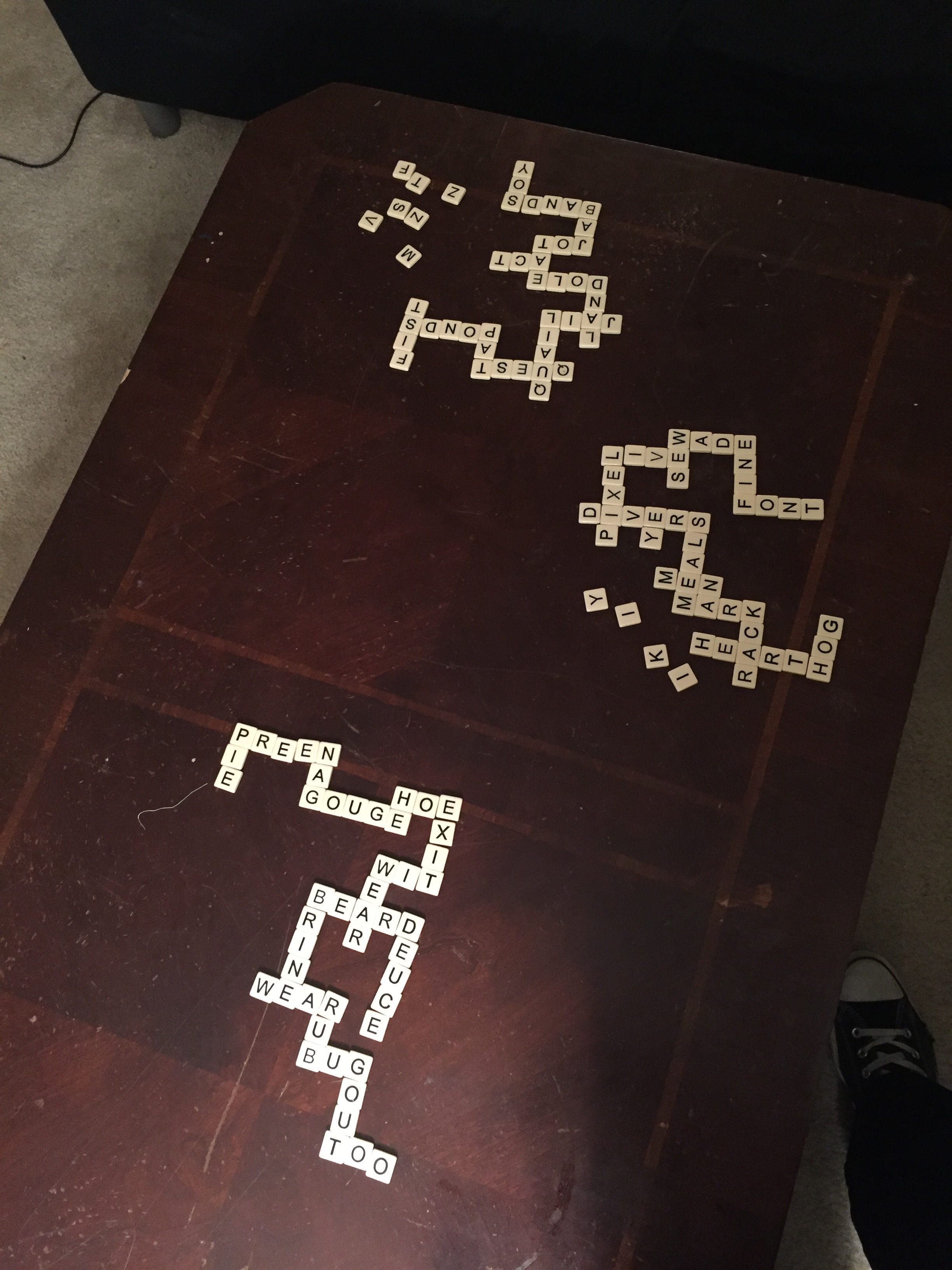
To round out my few weeks of games that aren’t confined to a board, I pulled a game off my shelf that I haven’t played in a while called Bananagrams. Basically a fast-paced Scrabble with no limitations on space, Bananagrams is a fun game for families that involves thinking and acting quickly.

The original Bananagrams 2of the fruit-based games created by Rena and Abe Nathanson, Bananagrams focuses on quick real-time action where you work to use up all of your tiles and create a makeshift Scrabble “grid”. You start with 21 tiles and once you use them all, you yell, “Peel” and everyone has to take one more tile. The process continues until there are no tiles left, and then the person to use up his or her last tiles wins… assuming he or she spelled every word correctly. If there are misspelled words, that player is disqualified and all other players resume play until someone else finishes.

The game has a lot of similarities to Scrabble; by the end of the game it even looks like there are multiple small Scrabble boards on the table. The number of letter tiles and the frequency of how many tiles each letter has are also very similar. However, there are some major differences as well. The letters you draw don’t have any specific value to them; playing a Z as opposed to an A doesn’t have any inherent differBananagrams 3ence. There’s also not as much of an advantage of playing large and complex words, though more words means less extra tiles and an easier time playing off of them in your connected grid. Being able to play two-letter words is just as important as playing seven-letter words. Speed is the priority, and the ability to change your grid when necessary to accommodate the new tiles you draw.

The pros of the game are that it is engaging, fast-paced and constantly evolving. It’s tough to get the nuances of how to play each tile effectively, but once you get the hang of it it’s a great game to play on game night. Another advantage is that the bettBananagrams 4er you do at the beginning of the game, the easier it is to stay in the lead since you only have one tile to work with. This challenges your opponents to use an ever-increasing set of tiles while you work to grow your lead. Finally, he variety of each game is also a plus because there are plenty of tiles and you will always draw different combinations and have to use different words.

The cons of the game are in the one-sided nature of pulling the tiles randomly. There are times when you get three Qs and no vowels and you’re stuck no matter how much you change around your grid. You do have the ability to exchange tiles for new ones, but it sets your game back and makes it difficult to keep up with others who drew well. That and the fact that your grid can go all over the table in every direction, and sometimes you have to shift it (which can take a while), mean that the game can be very frustrating at times.

Ultimately the pros of the game outweigh the cons and it’s definitely worth playing if you like word puzzles and brainteasers. It’s cheap and easy to transport, so it’s also good for family trips.

Jack’s rating: 3.5/5 stars

Board Game of the Week- Exploding Kittens

Exploding KittensGame Title: Exploding Kittens

Release Date: 2015

Number of Players: 2-5 (4 is recommended number)

Average Game Time: 15 minutes

Game Publisher: Self-Published

Game Designer: Matthew Inman, Elan Lee, Shane Small

Expansions/Alternates: No

Available in Stores: Yes

Age Restriction: 30 and up? (In all honesty, probably not suited for anyone under 18)


Holy crap guys, this game. Where do I begin to explain the insanity that is Exploding Kittens? Created and published by 3 clever (and somewhat twisted) individuals, Exploding Kittens found an extremely high level of success early in its Exploding Kittens Boxdevelopment through an aggressive Kickstarter campaign. When it was first created, Matthew Inman (creator of The Oatmeal comics), Elan Lee (Game designer for Xbox/ARGs), and Shane Small (Xbox/Marvel game designer) all got into a room and had a conversation that I pretty much assume went exactly like this:


Inman: OK guys, we need to create the most ridiculous game concept in the history of mankind so I can have an excuse to draw a cat shaped like a taco. What are your thoughts?

[pause for dramatic effect]

Lee: I’ve got it! A game where we draw a bunch of funny versions of cats… that EXPLODE!

Small: Brilliant! And we should totally add back hair, unicorn enchiladas, worm holes, and goats into the mix!

Inman: Whoa, hold on guys. This idea… NEEDS MORE LASER BEAMS!

All: YES!!!


That’s what I think happened, and if you tell me it went any other way I won’t believe you.

Now to get into the gamKitty-Powered Russion Rouletteeplay itself; you can pick up this game and be a master at it within about 5 minutes. The concept at its core is a card game equivalent to Russian Roulette, with some added twists and strategies to make the game more interesting. You draw and play cards until you draw an exploding kitten card, and unless you have a defuse card (you get 1 at the beginning of the game and more are added to the deck) you lose the game and are “out”. The last player standing is the winner.

I think it’s safe to say that the best quality this game has is its humor. Just check out this YouTube video to show how ridiculous and entertaining the creators and the game both are:

https://m.youtube.com/watch?v=hS0Q-KbCsp0

There was a lot of creativity, randomness, and art all thrown together and added into a deck of cards. It ends up being a very fun game that makes you laugh almost constantly as you play, especially for the first time. The gameplay is simple but gets exciting as the game gets closer to the end, and even losing early isn’t so bad because you can watch events unfold quickly from the sidelines.

Replay value is moderate; you will want to play the game multiple times when you first get it, but it will probably be a game you will play in bursts. Once you’ve read all of the cards and laughed at their wit and humor, it won’t be the same game experience until you take a break from the game for a while. In addition, the simplicity is great for first time players but also makes the game less captivating after a few playthroughs.

Ultimately games are supposed to capture your attention, bring you and your friends together, and be fun. Exploding Kittens does all three of these things and does them well. I highly recommend this game as a fun alternative to actual Russian Roulette, which I hear is not the best way to spend an evening (citation needed).

Jack’s Rating: 4/5 stars

Board Game of the Week – Pandemic

Pandemic 5   This week, I am reviewing the critically acclaimed Matt Leacock original Pandemic. With multiple different awards from well-known game industries such as Board Game Geek and Boardgames Australia, Pandemic focuses on working as a team to stop a series of virus outbreaks from eradicating all of mankind.

Game Title: Pandemic

Release Date: 2007

Number of Players: 2-4 (4 recommended)

Average Game Time: 45 minutes

Game Publisher: Z-Man Games

Website: http://zmangames.com/product-details.php?id=1246

Game Designer: Matt Leacock

Expansions/Alternates: Yes

Available in Stores: Yes

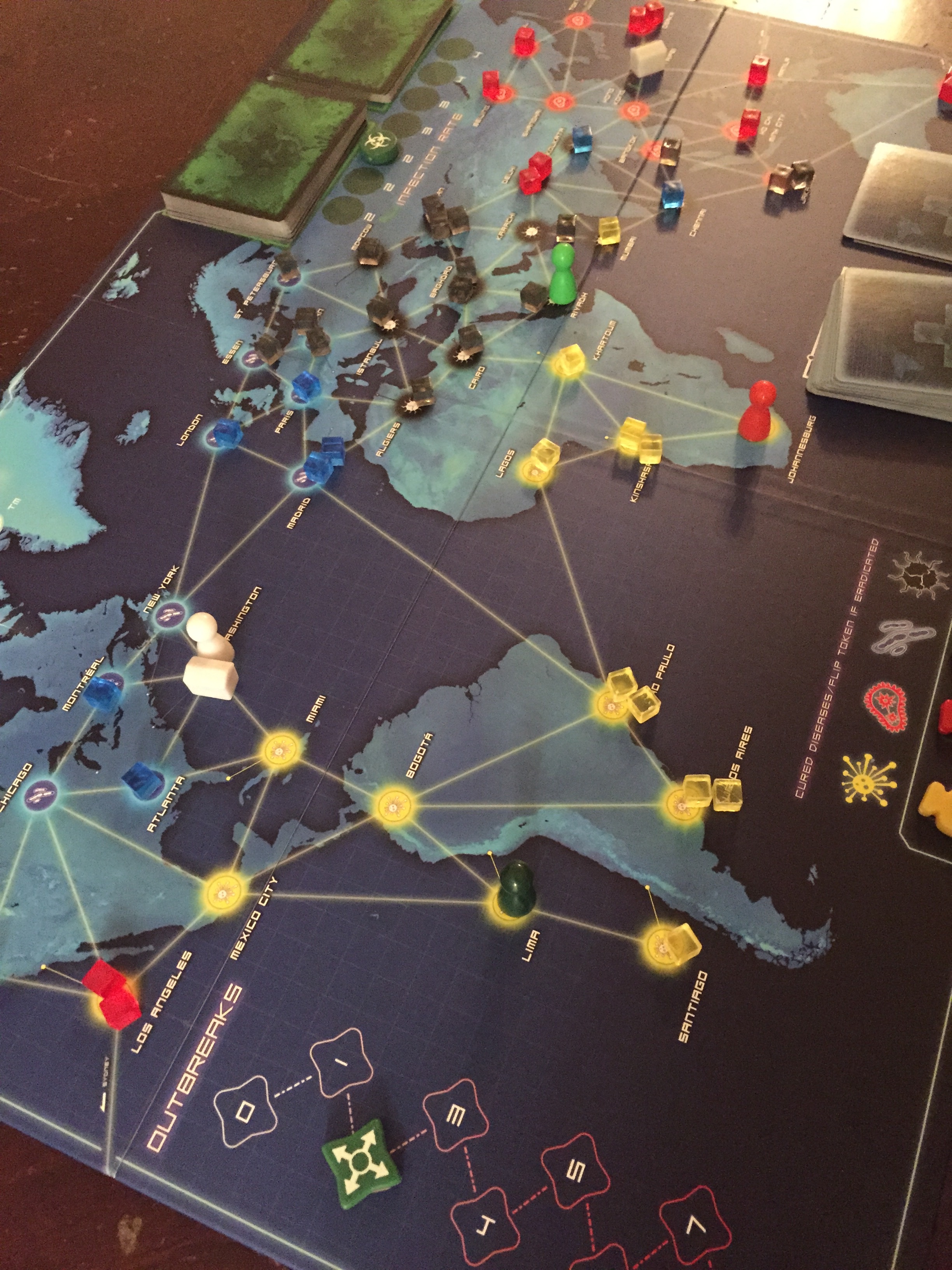
There aren’t many board games out there that ask you to combine forces against the game itself. A lot of the fun of playing games is playing against friends and family so that when you win, you can claim superiority over them (at least that’s what I enjoy about it). Still, there are a few games out there that find a way to create some form of villain or obstacle, and the object of the game is to join forces and defeat it as a group.Pandemic 4 One of the games that does this best is Pandemic, where you have to communicate and work as a team to claim victory as a single unit.

The object of this game is to stop virus outbreaks from infecting the entire world and finding cures so that you can eradicate the virus from the planet. No pressure, right? You travel around a map of the world and try to contain the 4 different viruses currently infecting the cities around the globe. The more the virus spreads, the harder it is to contain it. While you work to contain the virus, your team will also be focused on finding a cure. If you are able to cure all four viruses within the allotted time, you win. If you take too long or allow enough “outbreaks”, you lose. There are a number of other factors involved with the game, including research stations to contain outbreaks and look up cures, Epidemic cards that when drawn add more of the virus across the board, and numerous different types of event cards that bring a level of complexity and variety to the game.

Pandemic 3By far the most appealing thing about this game is that it allows you to work as a unit, but keep an individual identity during the game. Each player starts off with a specific “role”. There are seven roles you can play in any given game, and each one of them has a specific skill that can be used to improve your odds at winning. For example, the player with the Dispatcher role is able to move the other players’ pawns across the board easily, while the medic is better than the other players at stalling outbreaks. A huge part of the game is working together in order to use your role’s strengths. The more you’re able to help each other, the easier it is to complete your objectives.

The game is definitely complex, not so much in how to play but rather in the strategy and decision-making that goes into a successful game. The more you know about the game the more fun it is, because you can try a number of different strategies and work with your team members to win. Replay value for this game is high, especially since you learn more as you go and get better at playing at harder difficulties. The only real flaw in the game is the beginning; learning how to play and the best way to use your role takes effort so it can be confusing to people playing for the first time. I definitely recommend for your first play-through trying to play the game with someone who has played before rather than having a group of people with no experience. Having someone who knows the game takes some of the pressure off since they know how the roles work and the best ways to win.

Overall this game is a nice change of pace from the traditional competitive games, and the art and game play are big positives. The rules are fairly complicated and game-play can slow from player to player, but Matt Leacock has found a way to motivate people to work together in an industry that normally pushes for competition against each other. Be prepared to do a lot of critical thinking and scheming with the other players to claim victory against the ultimate Pandemic.

Jack’s Rating: 4/5 stars. pic1534148

Board Game of the Week – Ticket to Ride

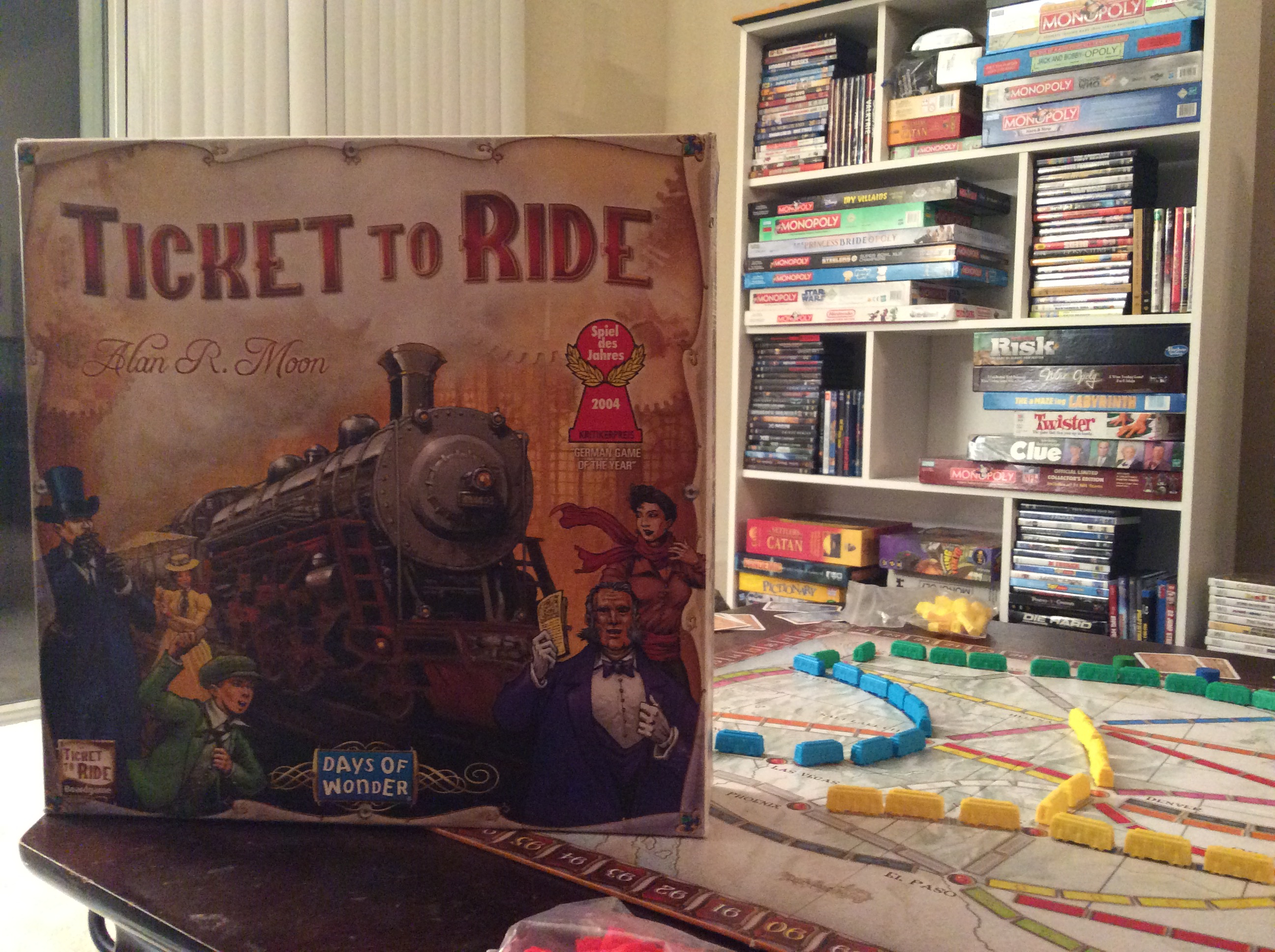
Each week, I’m going to review a board game that I’ve played and post the full scoop. This week, I’m going to talk about the Days of Wonder hit Ticket to Ride.

Ticket to Ride picture 3

First, the basic details:

Game Title: Ticket to Ride

Release Date: 2004

Number of Players: 2-5

Average Game Time: 30 minutes-60 minutes

Game Publisher: Days of Wonder

Game Designer: Alan R. Moon

Expansions/Alternates: Yes

Available in Stores: Original version yes, alternates and expansions online

Ticket to Ride picture 1

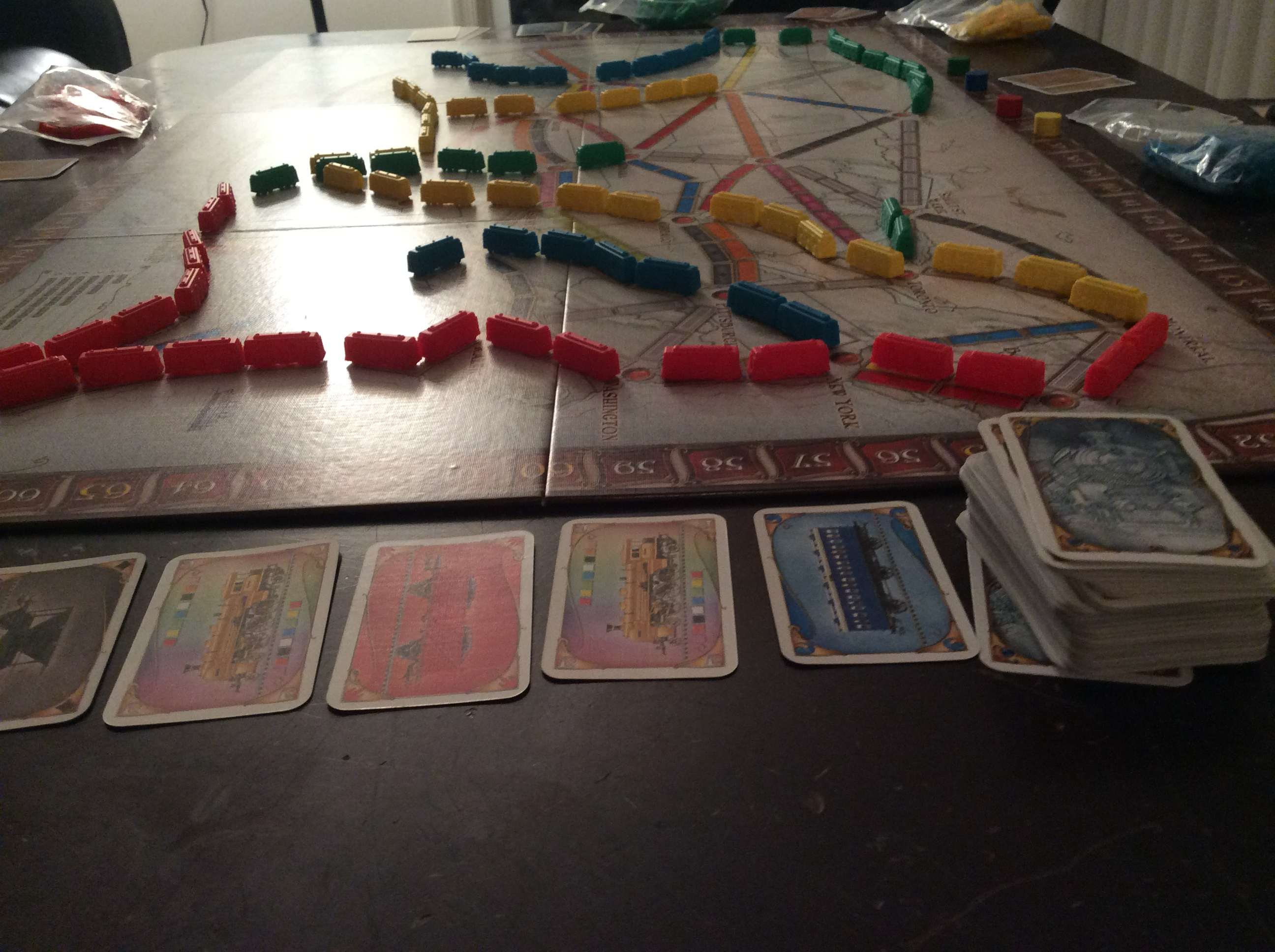
Ticket to Ride is a game with a simple concept that involves 2-5 players trying to expand their railroads across the United States (or Europe or the Nordic counties if you play the alternate games). The object is to create railroad paths from city to city to earn points based on “Destination Tickets” acquired throughout the course of the game. Once a player has used up all of his or her train cars, each player has one more turn to complete his or her tickets. If a player doesn’t complete the tickets, he or she loses the points normally awarded for finishing the paths.

Ticket to Ride picture 2

I think the main appeal of this game is that it’s fast-paced but still requires a lot of strategy. Players can only complete one of three options each turn, and each turn goes by quickly so nobody sits around waiting for long. The strategy of where you place your train cars is extremely important; you can choose to either take direct routes from city to city or take an extremely long route to get to multiple destinations in one go. You can also block other players from getting to certain cities, denying them points they would need to win. Replay value is high because strategies and routes change, though it isn’t a game that you should plan on playing more than two or three times in one sitting.

Overall, I highly recommend this game for a small group with an hour or so to kill. Families will enjoy it, as well as groups of friends who are competitive and willing to give something new a try.

Jack’s Rating: 4.5/5 stars