
Christmas: A Time for Family (and board games)

Christmas Trees

If I were to choose a favorite holiday, I would probably say Christmas gets the #1 spot in my book. I have so many amazing memories surrounding Christmas; traveling down to Florida with my family, spending time with my relatives from my mom’s side of the family, and calling my dad’s extended family in England to wish them all a Happy Christmas… The gifts were obviously a big part of my youth, but now looking back it’s really all about the family to me. I’m blessed to have extended families on both sides that get along and want to see each other, rather than the stereotypical dread that revolves around some holiday gatherings. Are these Christmas vacations I remember perfect? Of course not. Cousins bicker, Uncles and Aunts have to work late hours, people get sick (usually me for some reason…) and the magic of Christmas seems slightly less magical with the passing of my Grandma this past winter. But still, leading up to December 20th when I drive myself up to Pennsylvania (we switched venues a few years ago from sunny Jacksonville FL to snowy Gibsonia PA) I can’t help but smile at the idea of seeing my family soon.

One of the highlights about the family vacations is seeing my cousins on
my mom’s side: my sister and I are the oldest (she’s two years older than me), and then I have two cousins in college (Betsy and Lauren) and two in High School (Stephanie and Billy). Since all of my cousins are younger than me, watching them grow up can be a very strange feeling. When my mom told me that Betsy had started driving I remember looking at her and telling her that I didn’t believe her. The days when we were all under 5 feet tall couldn’t have been that long ago right? Still, it’s great to see that they are all growing up to be smart, talented, and moskeep-calm-its-just-a-family-reuniont importantly genuinely kind and good people.  Sure, we have our fights, and I know that sometimes I can be inattentive as a cousin, but there are so many great memories it’s like the bad ones don’t even exist in my mind. OK, so now that I’ve gotten the mushy stuff out of the way, I bet you’re thinking “that’s great Jack, but why are you talking about all of this on a blog about board games?” I’m glad you asked random reader, because this article has one very specific purpose: to show you how tabletop games can make Christmas better.

As I have mentioned in previous posts, I play a lot of video games in my spare time. This was especially the case when I was in High School; any chance I got to play video games I would take. The problem was that I was also a very active High Schooler, so whether I was playing in the band, singing in the choir, or hitting serves on the tennis court, I was always busy after school and didn’t have much time when I got home what with homework and that whole “sleeping” thing. So my brilliant solution to this issue was to take my Xbox 360 with me to Florida! It’s vacation, I’ll have tons of time to play the new games I got right? Well, technically yes, but it had a bit of a backlash when it came to my cousins. Now, I’d like to preface this by saying that I wasn’t intentionally trying to ignore my relatives; the issue is mostly revolving around the fact that kids change when they get older. When they were younger, my cousins all really enjoyed watching me play games like Luigi’s Mansion or Pokémon Snap (bringing back N64 game references… I must be getting old). But as we all got older, the types of games I liked changed to one-player adventure games like Prince of Persia or Assassin’s Creed, and my cousins started to become bored with the idea of sitting around a room watching me play a game they couldn’t enjoy themselves. So slowly but surely, things got more frustrating for them (while I remained oblivious) until one cousin said to me “all you do is play video games when you’re here, so what’s the point of you even coming?” And suddenly I realized that what I wanted to do when I was on vacation wasn’t the same as what my cousins wanted to do. I left Florida that year feeling guilty, but also not knowing what would happen when we returned the next year. Should I stop playing video games around the holidays? Is it alright to get a little bit of time to myself to play, or is that selfish? Luckily enough, the next year ended up being one of the better ones, and paved the way for a new tradition on Christmas.

Christmas next year started off a similar way- I pulled out the consoles I had brought with me and my cousins rolled their eyes. We had dinner, we chatted, and things were fine but there was a feeling that it could go south if I moved towards my Grandpa’s den, where my video games were all set up. And then my sister made a recommendation that I will always appreciate: why don’t we play a board game after dinner? It just so happens that one of Katie’s new gifts was 7 Wonders, and she wanted to teach us to play.

Sure enough, we all sat down and labored through the tutorial and finally started to get the hang of things in our first play through. And suddenly, it was as if last year had never happened. I can’t stress enough that games are great at bringing people together- you can focus on a fun activity, but also have time to catch up, joke around, and all in all have a great time. 7 Wonders has become a favorite of ours to play, but we’ve also brought along games like Clue, or Settlers of Catan, or the Lego creation game called Creationary. Not all games are a hit (a two hour game of Settlers of Catan has spoiled it for my cousins somewhat) but no matter what happens with the game we enjoy ourselves. We don’t spend all vacation playing board games of course: we go outside and throw a football, build puzzles, watch TV, and yes I do get some video game time every once in a while. But the games are always a fun part of what we do. I’m looking forward to seeing what new games we play this year, but more than that I’m looking forward to spending time with my family.

So if you spend time with your family this Christmas, I recommend you find something that connects you in the same way board games have connected my family. Ultimately, if you look past the gifts and the food, Christmas is a time for family, and for me that time is something I get to enjoy with some slight help from board games along the way.
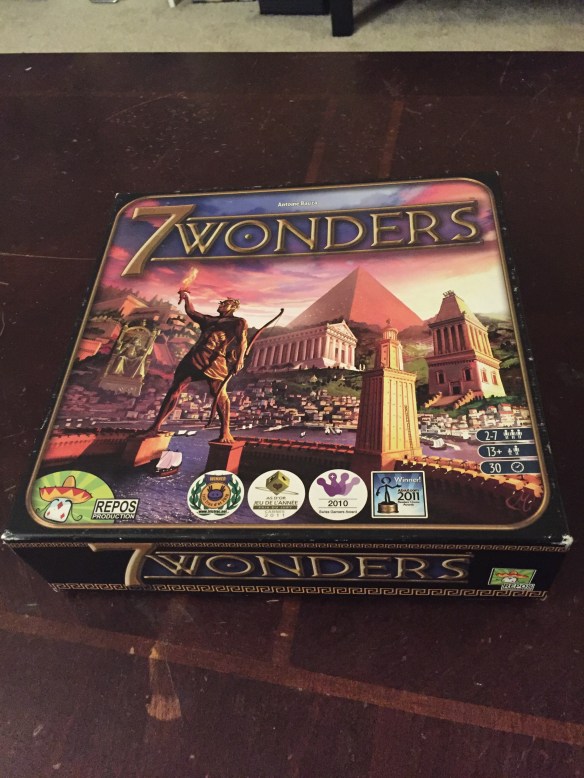
Board Game of the Week- 7 Wonders

image1

  • Game Title: 7 Wonders
  • Release Date: 2010
  • Number of Players: 2-7
  • Average Game Time: 20-30 minutes
  • Game Publisher: Repos Production
  • Website: http://rprod.com/index.php?page=description-22
  • Game Designer: Antoine Bauza
  • Expansions/Alternates: Yes
  • Available in Stores: Yes

Some board games have a simple style that you learn quickly and then play, without any additional strategy involved. In contrast, there are games that take a lot longer to learn and even once you’ve learned, there is still an opportunity to learn and improve because of the strategy involved in mastering the game. 7 Wonders definitely falls into the latter type of game. I’ve tried to explain the game multiple times to new players and have always received looks of confusion and frustration right away. However, once they start to play and get the experience of “learning by doing”, it all starts to make sense.

I’m not going to go into all of the details of how to play the game (I would be writing a 10 page essay), but the basic premise and rules I can try to explain. To start, each player randomly chooses an individual board with one of the 7 wonders of the world: Babylon, Gizah, Rhodes, Alexandria, Halikarnossos, Olympia, and Ephesos. These boards each have different resources that they provide as well as different “wonders” that have additional benefits as the game goes on. Gameplay is completed through a series of cards that are distributed evenly through three “ages”. There are multiple different types of cards, such as resource cards, science cards, army cards, and more. Using the cards that fit with your Wonder and your overall strategy is the key to win.

To play the game, each player takes his/her cards, chooses a card to play, and plays it at the same time as the other players. The hands are then given to the player directly to the left, which becomes the hand used to play the next card. This process continues until each player has two cards left, when the players each choose one card to play then discard the other. Finally to end the age, each player goes to war with the players directly to their left and right, providing points to whomever has the most army cards. The second age follows the same process except the players hand their cards off to the right, and then the third age switches back to the left. After all three ages are completed, points are calculated based on the cards played, along with war points and points from Wonders. The player with the most total points from all of these factors wins.image2

Reading my explanation of how the game works probably doesn’t do it justice, but I hope that it gets across the vast number of strategies and cards that are involved in every game. That’s the biggest benefit of 7 Wonders by far, is that you can use countless different strategies to succeed. You can build up armies, improve your sciences, create more culture through monuments, or build your wonders to gain points, and any mix or combination and more will lead to your total score. Another advantage of the game is that once you get the hang of it, it isn’t a particularly long game. You can feasibly play the game 3 or 4 times within a two hour period, which gives you the chance to try out new Wonders and strategies and keep things fresh.

Ultimately the downsides of the game are focused around the steep learning curve. I’ve had friends who tried to get into the game but didn’t have the patience to learn the rules and ended up losing interest before they got the hang of it. It’s also a game where you will be constantly checking the rulebook because the card descriptions are extremely vague. I’ve played the game dozens of times and still don’t remember what certain cards or wonders do. Finally, the game is fun with any number of players but when you get to 5+ it gets harder to keep your area organized because so much space is taken up with your board, cards, coins, etc.

While the game may not be for everyone, 7 Wonders is a great game to play in the right setting. It’s also a good game to have as a staple in your game nights. I also recommend taking a look at the expansions out there, because once you expert the game it’s fun to add in additional layers to it.

Jack’s Rating: 3/5 stars

Monopoly Rules- the Good, the Bad, and the Ugly

Monopoly-rules

As I said in my recent blog post In Defense of Monopoly, one of the major advantages to the game Monopoly is its malleability. There are a number of “house rules” that are used as if they are a part of the game, while other rules are ignored completely. Sometimes it seems like everywhere you look, a different set of rules is being used when playing this classic game. A lot of the rules that are added (or scrapped) add to the fun of the game, but there are also rules that can directly result in the game being drawn-out and less enjoyable overall. After having some experience playing numerous different types of Monopoly boards and implementing all sorts of different rules, I have come up with some observations on the best way to ensure your Monopoly game is played with rules that will enhance the game rather than drag it down. I’ve split the types of rules up into three sections: official rules, house rules, and new rule suggestions.

Official Rules

1) Auctioning Property- The official rules in the Monopoly rulebook state that, “Whenever you land on an unowned property you may buy that property from the Bank at its printed price… If you do not wish to buy the property, the Bank sells it at auction to the highest bidder. The high bidder pays the Bank the amount of the bid in cash and receives the Title Deed card for that property. Any player, including the one who declined the option to buy it at the printed price, may bid. Bidding may start at any time.”  I can’t tell you how often this rule gets overlooked or ignored when I’m playing with friends, but truth be told this is an extremely important rule to utilize if you want your game to start off fast. Auctions aren’t necessary to play the game, but they do drive it forward at a faster pace and they also require a significant amount of strategy. Auctions are a good way to keep the game fair too- someone could have few properties but a large amount of money, and the ability to auction will help them get back in the game. Ultimately the start of a game of Monopoly without auctioning is fairly dull and can allow a player to pull ahead early, so the ability to auction helps balance the scales and keep things moving.

2) Mortgages- Mortgaging a property can seem like a pain, but it is a good way to ensure that you are not eliminated from a game. One of the paramount strategies of Monopoly is to keep your monopolies intact to increase your odds of a big payout. But if you land on someone’s property and have to pay up, it’s difficult to keep your houses/hotels on the board in order to do some real damage. The ability to mortgage should be used when possible, but should also not be taken lightly. I’ve seen people disregard the 10% interest rule when mortgaging; ultimately that seems like a good way to keep players who got hit hard in the game, but it also gives people an opportunity to mortgage cards early for short term gains without penalties when they want to un-mortgage the property. This is one of those rules you should keep intact.

3) Buying and selling houses/hotels- As I’ve said before, building on monopolies is a big part of success in a game. However, there should also be a cost if you try to expand too quickly and it backfires. The official rules state that if you have to sell back a house or hotel, you only get half of the money you originally paid for it. This rule is extremely important to ensure that players do not spend all of their money on hotels at once- a gradual pace for hotel building is a good way to keep things more evenly matched. Selling houses and hotels should be considered a last resort, and being able to get your full money back diminishes the risks of investing in your monopolies.

House Rules

1) Free Parking Money- This is the most wildly-contested rule out there; is there supposed to be money in free parking? If so, how much? Do you add money from income taxes to the free parking “pot”? Ultimately this iFree Parkings not an official rule to Monopoly, but it’s an extremely popular one and is used in a variety of different ways. I personally believe that this is a good rule because it has the ability to provide alittle extra respite to players down on their luck. The ideal scenario in my opinion is to add $500 to the free parking pot at the beginning of the game, and then once somebody
lands on it, you refill it by that same amount. No income tax or Chance/Community chest money should go into the pot, so that it acts solely as some additional funds rather than a complete game changer.

2) Landing on Go- This rule revolves around the idea of “Passing” go and collecting $200. This is what the board and the rules say, but what happens if you land on Go? Officially, nothing would happen, because your piece has to pass the space before you receive the money. However, there is a house rule some people use to provide an extra reward for landing on Go. In this scenario, you actually receive $400 if you land on go as opposed to pass it. I have no issue with this rule, but I do recommend setting it up with a slight addendum; when you land on Go you receive $200, then get the extra $200 on the next turn after you’ve passed the space. That way a player isn’t automatically flush with $400 cash in one turn, but still gets the extra award for landing on Go.

3) Trading properties- Trading properties is an essential part of Monopoly. The ability to trade for monopolies is an important way to ensure that you can advance the game, but it is not officially stated in the original rules that trades are allowed. While trading is necessary to create a more fun game, it also has the ability to cause skewed games from lopsided trades. Because of this, I have a slight alteration on the standard trading process that I recommend. Rather than trading at any point in the game, a player can only propose trades on their turn. Trades are completed before any dice are rolled, and if the trade created a Monopoly that player can’t add houses or hotels to the new monopoly until his/her next turn. Finally, if there are more than 4 players playing the game and at least 3 people consider the trade to be unfair, they can reject it (this is not something I’ve ever practiced myself, but I think it would be more likely to ensure a single player doesn’t run away with the game).

New Rule Suggestions

1) Jail- I can’t even describe how infuriating it is to watch someone get carted off to jail (metaphorically of course) right before landing in my monopoly area, and then have myself land on their property and lose everything while they sit pretty for 3 turns. Because of this, I recommend a rule variant that isn’t used by many but should be a positive change to the game. If a player is put into jail, they are then officially unable to collect payment from a player landing on their properties, and also cannot buy hoMonopoly Jailuses or hotels until they are released. The player can buy out of jail at any time in the 3 turn stint, but ultimately if the player stays in jail no players landing on his/her properties will have to pay the fees associated. This will cause players to want to leave jail earlier, which will speed up the game and make sure that each player has greater chances of landing on an opponent’s space.

2) Starting Game, Property Buying Delay- This is a rule I’ve played with my friends in the past to varying success. The concept is that you have to pass all the way around the board once before you are allowed to buy any properties. The rule is supposed to promote fairness since generally speaking the player who goes first in traditional Monopoly has a higher chance of winning properties. However, if a player lands in jail or rolls poorly during the first few turns, he/she becomes crippled by the rule and it makes it that much harder to get back into it. Ultimately there are pros and cons to this rule, so there’s no harm in trying it yourself but I would not recommend it as a must-rule to improve the game.

Ultimately these rules are about creating the best experience you can when playing Monopoly. This means that if you don’t like one of the rules, you shouldn’t use it, and instead use whatever rules you find to be the most fun. There are also rule variants out there for intentionally shortened games, so if time is the major concern there are options for fixing that. If you have any other cool ideas (I know that Past Go’s writer Geoffrey Greer was looking into a variant that could break apart an opponent’s monopolies mid-game) then send me a comment about it!

Board Game of the Week- NFL 1998 Monopoly

IMG_2712Blog #14- Board Game of the Week- NFL 1998 Monopoly

  • Game Title: Monopoly: NFL Official (1998)
  • Release Date: 1998
  • Number of Players: 2-8
  • Average Game Time: 60 Minutes
  • Game Publisher: Parker Brothers
  • Website: http://monopoly.wikia.com/wiki/NFL_Official_Limited_Collector’s_Edition
  • Game Designer: Uncredited
  • Expansions/Alternates: None (unless you count all other Monopoly games, ever)
  • Available in Stores: No (available online)

For those of you who don’t know much about me, I am a big NFL fan. On any given Sunday during football season odds are astronomically high that I’m spending the day sitting on the couch watching NFL Redzone all day and checking my fantasy football scores. So when I say that my favorite type of Monopoly board is based on the NFL, that fact should not be surprising to you. What might be surprising is the fact that the game I am playing is from 1998. This is actually the very first non-traditional Monopoly board that I played, and it was the beginning of a growing collection of different types of Monopoly boards.

The similarities of NFL Collector’s Edition Monopoly are fairly obvious- the number of properties, players, and board are all the same setup as a regular Monopoly board. You still have Jail and Free Parking and you still pass go and collect $200. The important rules and regulations of the game all mirror the Monopoly everyone has grown up playing. So what’s the difference? It’s all in the aesthetics. The properties, rather than being locations, are NFL teams. All 31 NFL teams are represented either as their own property, or in groups of teams listed as the “railroads”. Rather than houses and hotels, you buy sections and stadiums. Instead of Chance and Community Chest, the card selections are from AFC and NFC to represent the NFL’s two divisions. Even the dice and tokens are different, with custom football-shaped dice and NFL themed silver tokens. The gameplay is almost identical to your average game, yet the feel is totally different because of the different look.

IMG_2711

I think my favorite part of this game is about the nostalgia. For any football fans over the age of 25, you will love seeing where all of the NFL teams are on the board. A few prime examples: The Jaguars are the 5th most expensive team on the board, and the Cardinals and Colts are the two least expensive. It’s just wild to look back at how different the NFL was only 17 years ago- there weren’t even 32 teams at the time! But nostalgia isn’t the only fun aspect of the game- Parker Brothers took this theme and made the most of it, and it makes it a lot of fun. The NFC and AFC cards are all football-related events, with pictures of the Monopoly Man in football gear being traded or fighting off injury. On top of all that, the game runs like standard Monopoly, so the different theme doesn’t affect gameplay.

Downsides are the normal downsides that come with Monopoly- longer game times, slower pace of play, and a possibility of players to run away with the game if luck is on their side. Ultimately my enjoyment of Monopoly is higher than most, so I understand that I do have a bit of a bias here. Still, the NFL edition of this game is just as good as the standard version of Monopoly, so feel free to take that however you would like. It’s a great game to add to the collection for any sports fan looking for a reminder of the good ‘ol days.

Jack’s Rating: 4/5 stars

In Defense of Monopoly

Monopoly Boards

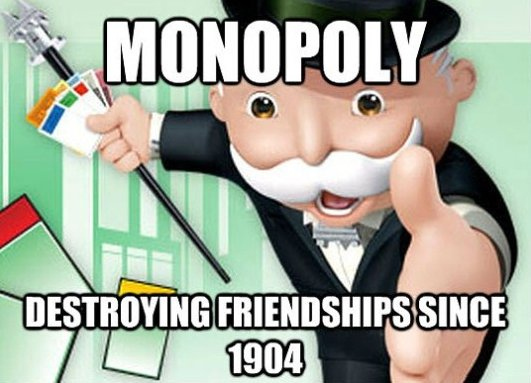
I can’t tell you how many people I know that have a burning hatred towards Monopoly. It honestly surprises me that whenever someone sees my Monopoly board collection for the first time, they almost always talk about what an annoying/long/tiresome game it is. Sure, the average game of Monopoly can definitely take longer than other board games, but it’s no longer than Risk, Axis and Allies, or even Munchkin. And yet of all of the games that are on the market today, Monopoly is one of the most successful and long-lasting but also one of the most criticized. Any time I browse the Internet I randomly see memes or pictures like this sprinkled around:

monopoly ruining friendships

Personally, I’ve been a fan of the game Monopoly ever since I was young. I played it with friends through high school and still play it with my roommates every once in a while when we’re all in the mood. I have 12 different Monopoly boards and have fond memories of playing all of them at different times in my life. So in honor of one of the most iconic games created in the 20th century, I’m going to explain why I believe that Monopoly is actually a great game to play and should always be a staple of your board game nights. Here are my top 5 reasons why Monopoly should be celebrated in the board game industry:

1) Easy to learn, but hard to master

One thing that can always be frustrating about board games is the time it takes to pick up on how to play. A game that is easy to learn quickly is one that will grab your attention faster and will be more likely to keep you playing, provided it stays interesting over time. When you look at Monopoly at first it may seem more complicated, but the concept is straightforward enough to pick up fairly quickly and not be far behind people who have played the game before. On the flipside of that, the game is actually surprisingly tough to master in certain ways. Sure, everyone can play the game without much strategy involved, but when you get into a group of competitors you start analyzing every move you make, every trade you attempt, every time you buy a hotel, to the point where you have to be very knowledgeable about the game itself to be an expert at it. The game allows for novices to play and have fun, but can also bring a significant amount of challenge to it when the setting is right.

2) Quick changes to the “Leader Board”

Sometimes when you play a board game, a single person will start off strong and you just won’t be able to keep up. That’s not the case when you play Monopoly- in fact, lead changes are fairly frequent once you get into the later stages of the game. Generally speaking there is a point of Monopoly where everyone has one or two monopolies and is working to build houses/hotels on them. One bad move or bad roll during this time can completely change the dynamic of the game. Someone with houses littered across the board will suddenly have to sell them all back, and maybe even mortgage or trade properties to stay afloat. Fortune can change in the blink of an eye, and while it’s true that if a player gets very unlucky and has to mortgage most of their properties he/she will most likely be stuck in that hole, the truth is that there is a lot more variety in the game standings than people give it credit for.

3) Ability to make custom rules

If you were to take out any board game you’ve played before right now, odds are high that you would know a majority of the rules of said game and you would stick to them no matter what. That’s not the case with Monopoly. Monopoly is a game with more “house-rules” than I’ve ever seen. Maybe it’s because of how long its in production, but it seems like every time I play with different people I have to be prepared for a different set of rules. Rules like free parking, mortgaging, auctioning spaces, landing on Go, and many more are all up for debate, and so before the game is started you may have to suddenly adjust to the new rules that your friends/family have put in place.

4) Teaches kids basic business lessons

I remember playing Monopoly Junior when I was a kid, and spending a lot of time counting up my money and making sure I had enough to buy a hotel or a new property. Learning the value of trading,monopoly money understanding basic math and business, and figuring out when and when not to invest are just a few of the business skills you learn from playing Monopoly. Obviously in no way does Monopoly dir
ectly translate to the business world (if it did I would be rich by now) but you can’t discount its uses in teaching youth the value of fake pink colored money.

5) Different types of boards/games

When a game has been around for over 100 years, odds are high that gaming publishers will take advantage of its popularity by creating different versions of the game. While some people find this unnecessary, I find it one of the best parts about older games. You can find a Monopoly board with pretty much any theme you can think of: Doctor Who, Legend of Zelda, Family Guy, Disney Villains, even Elvis-Opoly is a thing. For these types of games the rules don’t vary much, but the properties, cards, and pieces are all based around the theme. The aesthetics are the important part, which makes having multiple boards unnecessary but ultimately a lot of fun. In addition to the Hasbro Monopoly alternative, there are some non-affiliated third party companies that created Monopoly-esque games with similar themes but slightly different rules and procedures. Games like Wine-opoly, Princess Bride-opoly, and even Create-your-own-Opoly fit into this mold.

So the next time someone invites you to play a game with them, I hope you consider the classic business game as a potential option. Monopoly has stuck around for a reason, and that’s because it’s a fun game that people enjoy playing no matter how many jokes are made at its expense. The next few articles I’ll be writing this week are all going to be Monopoly-based, so I hope you enjoyed this one and will enjoy the others too!

Monopoly Week


Board Game of the Week- The a MAZE ing Labyrinth

  • Game Title: The a MAZE ing Labyrinth
  • Release Date: 1986
  • Number of Players: 1-4
  • Average Game Time: 20 minutes
  • Game Publisher: Discovery Toys, Elmark, Estrala, Grow Jogos e Brinquedos, MoBi, Otto Maier Verlag, Ravensburger, Ronda
  • Website: No official site
  • Game Designer: Max J. Kobbert
  • Expansions/Alternates: Yes
  • Available in Stores: No (available online)

Time for a blast from the past- my board game of the week this week is from the 80’s and is one of my favorites from my childhood. The game is a strategy game called Labyrinth, though when I was a kid they called it The a MAZE ing Labyrinth (puns are fun!). For those of you who don’t have David Bowie singing in your head right now, you need to watch this move ASAP:

labyrinth David Bowie

Now the game doesn’t have any official affiliation with the movie Labyrinth, but it does have the same quirky feel to it. The game includes a board with tiles glued to it along with multiple “free” tiLabyrinth 1les that are placed in empty slots along the board. There is also a set of cards with pictures on them and four game pieces. To start the game, everyone chooses a piece and puts it on the designated starting square of that color, around the 4 corners of the board. The free tiles are placed randomly around the board, with all but one being added to the empty slots available (we’ll get to the leftover tile soon). Finally, all of the cards are dealt out evenly to the players and placed face down. Nobody looks at the cards, and you will only look at one card at a time.

To start the game, everybody draws a card without showing the other players and looks at the picture. That picture corresponds with one of the tiles of the labyrinth. The object of the game is to navigate through the labyrinth and land on the tile with the picture of your card, and then move on to the next card, etc. until you have landed on every card in your deck. Seems simple enough, right? Well the tricky part of the game lLabyrinth 2ies in the extra tile I mentioned earlier. The board is designed so that every other row is moveable by taking the free tile and pushing it onto the board, pushing off another tile in the process. Every time you take a turn you have to add the free tile to the board before your turn can end (you can do this at any point in your turn). This makes the game much more complex, because not only do you have to plan your route based on where you add the tile but you also have to take into account your opponent’s moves, all the while not knowing what picture they are trying to reach.

The best part about this game is the strategy involved- everyone has his or her own ideas for how to get to the correct picture, and everyone has to plan far in advance sometimes to get to the destination while also being flexible when someone moves the labyrinth in a direction you weren’t expecting. There are also a number of alternative strategies to the game, such as intentioLabyrinth 3nally pushing the tile you are trying to reach off the board or even pushing other players off the board (this takes the player back to where he or she started the game). It’s a fast-paced, easy to learn game that is great for a small group of friends or family game night.

The biggest drawback of the game is one that plagues many board games, and that is the luck of the draw. Ultimately where your tiles end up in the beginning of the game and what cards you were dealt are a huge factor in your success. This is not an uncommon thing in games, but there is something particularly frustrating about someone drawing three pictures, all of which they can get to within a turn, while you’ve been stuck on the opposite side of the board all game. Still, the ability to manipulate the board to your favor ends up being more important than where you are in relation to your tiles, so in most cases the games tend to be fairly even.

Overall the game takes the strategy of a game like chess or backgammon, the movement of a game like Monopoly or Sorry, and the added twist of a constantly changing board, and throws it into a fun and interesting theme. I would recommend the game to anyone, especially kids since it was one of my favorite games growing up.

Jack’s Rating: 4/5 Stars

Why the Internet has revitalized Board Games

http://www.boardgamegeek.com With the ever-changing technology that is the Internet, it’s no surprise how much it affects everything in our lives. This blog is just as much proof of that as anything; I can reach other board game enthusiasts from around the world in the comfort of my own home. As Bill Gates once said, “The Internet is becoming the town square for the global village of tomorrow.” So with this evolving landscape that the whole world is shaping, it’s no surprise that it is a force that influences the board game industry as well. What is surprising is that rather than diminishing the value of the board game, the Internet has actually helped improve the board game industry.

It seems sort of contradictory in a way; after all, board games are considered outdated by many people, so how has technology revitalized something so archaic? There are four major factors revolving around Internet usage that have helped the board game industry improve over the years: online purchasing, media and communication, online gameplay, and greater access to funding.

Online purchasing- the most obvious of the advantages of the Internet, being able to purchase a game online is making it exponentially easier to find all types of board games. Board game shops are becoming less common, and superstores such as Target and Wal-Mart have a limited supply of tabletop games in stock. In contrast, there are hundreds of online board game stores out there and ready to be used. Whether you buy online directly through a manufacturer, through a third party, or off of a secondhand/used game site, the ability to buy games online provides easy access to a desired commodity.

Media and Communication- Whether it’s through blogs, articles, or social media sites like Facebook and Twitter, online communication helps spread awareness of board games and allows for easier access to reviews and opinions about specific bgggames. The best example of this is the website www.boardgamegeek.com which has data on thousands of different games and includes a forum to ask questions to other board game lovers. Unlike TV where it is a one-sided conversation, the Internet gives game publishers a chance to advertise games and also allows customers to enjoy an open dialogue.

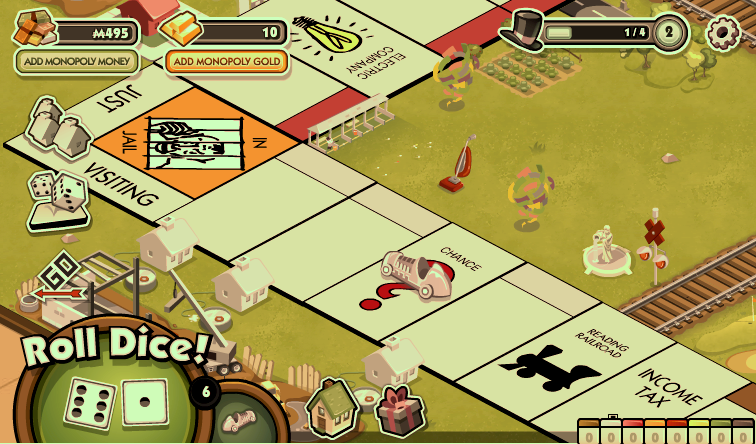
Online Gameplay- As I said before, board games can be considered archaic at times in comparison to video games or other types of games. So what’s a good way to make boar games more modern? Put them online to play! You can find games like Uno, Monopoly, Scrabble, and Risk online through various means. Flash games on Facebook also are a part of the craze, with games like Words With Friends and Trivia Crack channeling aspects of the popular board games on the market into an online equivalent to a board game.online monopoly

Greater Access to Funding- Let’s say you have an amazing idea for a board game, but can’t get a publisher to fund the game and don’t have enough money to start it yourself. What do you dokickstarter-logo? In the past you would have to take out a loan and risk your financial future for the chance of the game taking off. But now there’s a better way, and that way is the Internet. Advertising for funding from strangers may seem like an unlikely prospect, but it has started to take off in a way nobody would expect. www.kickstarter.com is the premier site for funding these kinds of projects, and there is an entire section of the site dedicated to tabletop gaming. Some notable board games funded by Kickstarter campaigns include Exploding Kittens, Scythe, and Zombicide: Black Plague. The fact that you can work for your game to be funded by people on the Internet is a huge boost to game designers all over the world.

The Internet took the world by storm, so sometimes it’s difficult to remember how new it really is. Board games have been around forever and the Internet is still just beginning. The fact that board games have not simply faded into the shadows, but rather took advantage of the new technology, says a lot about the industry and what it is working towards. If we’re lucky, board games will continue to grow and evolve while still keeping the aspects that we all love about them intact.

Board Game of the Week – Bananagrams

Bananagrams 1

Game Title: Bananagrams

Release Date: 2006

Number of Players: 2-8

Average Game Time: 15 minutes

Game Publisher: Bananagrams, KOSMOS, Vennered Forlag AS

Website: http://www.bananagrams.com/

Game Designer: Rena & Abe Nathanson

Expansions/Alternates: None

Available in Stores: Yes

To round out my few weeks of games that aren’t confined to a board, I pulled a game off my shelf that I haven’t played in a while called Bananagrams. Basically a fast-paced Scrabble with no limitations on space, Bananagrams is a fun game for families that involves thinking and acting quickly.

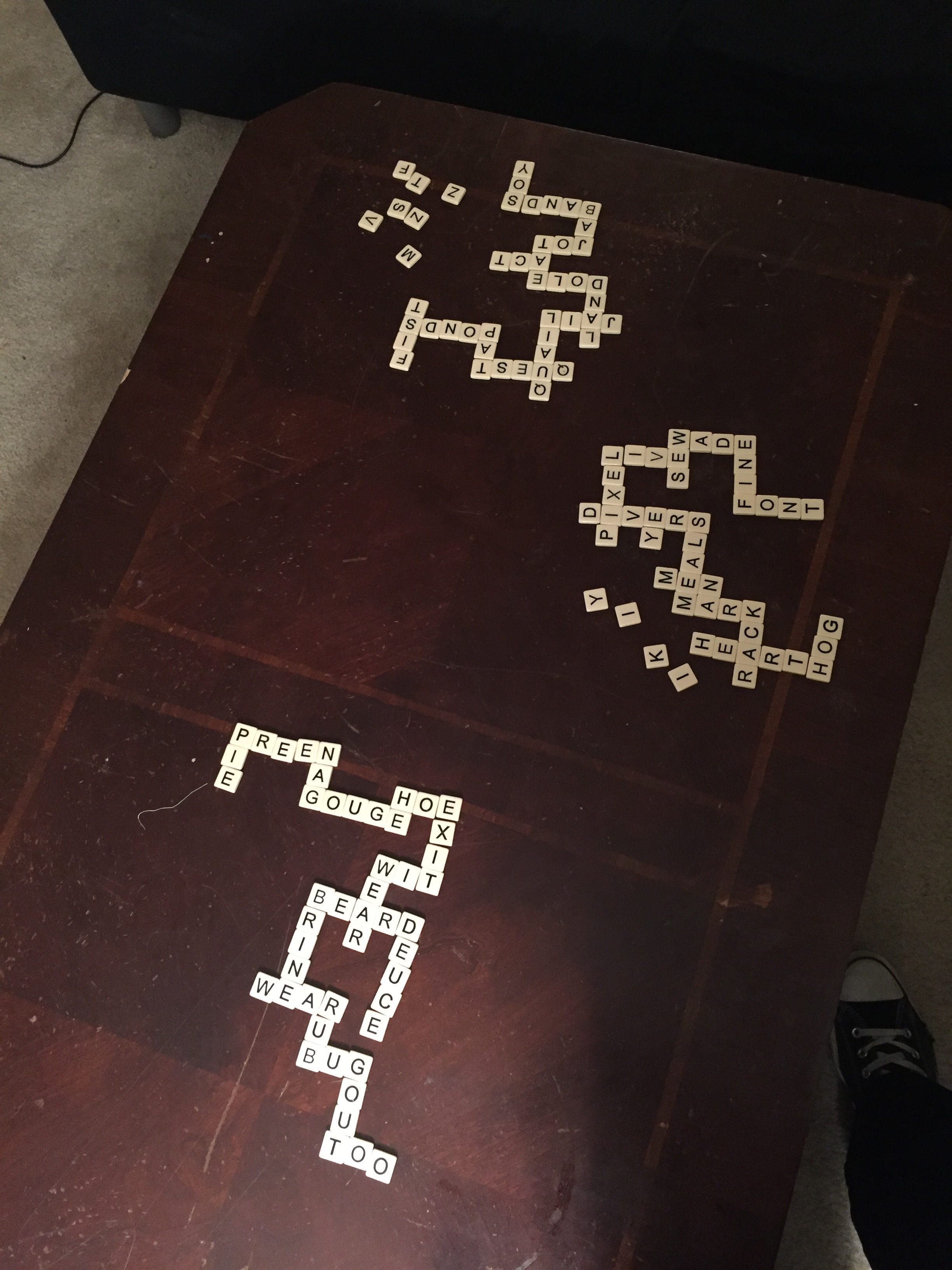
The original Bananagrams 2of the fruit-based games created by Rena and Abe Nathanson, Bananagrams focuses on quick real-time action where you work to use up all of your tiles and create a makeshift Scrabble “grid”. You start with 21 tiles and once you use them all, you yell, “Peel” and everyone has to take one more tile. The process continues until there are no tiles left, and then the person to use up his or her last tiles wins… assuming he or she spelled every word correctly. If there are misspelled words, that player is disqualified and all other players resume play until someone else finishes.

The game has a lot of similarities to Scrabble; by the end of the game it even looks like there are multiple small Scrabble boards on the table. The number of letter tiles and the frequency of how many tiles each letter has are also very similar. However, there are some major differences as well. The letters you draw don’t have any specific value to them; playing a Z as opposed to an A doesn’t have any inherent differBananagrams 3ence. There’s also not as much of an advantage of playing large and complex words, though more words means less extra tiles and an easier time playing off of them in your connected grid. Being able to play two-letter words is just as important as playing seven-letter words. Speed is the priority, and the ability to change your grid when necessary to accommodate the new tiles you draw.

The pros of the game are that it is engaging, fast-paced and constantly evolving. It’s tough to get the nuances of how to play each tile effectively, but once you get the hang of it it’s a great game to play on game night. Another advantage is that the bettBananagrams 4er you do at the beginning of the game, the easier it is to stay in the lead since you only have one tile to work with. This challenges your opponents to use an ever-increasing set of tiles while you work to grow your lead. Finally, he variety of each game is also a plus because there are plenty of tiles and you will always draw different combinations and have to use different words.

The cons of the game are in the one-sided nature of pulling the tiles randomly. There are times when you get three Qs and no vowels and you’re stuck no matter how much you change around your grid. You do have the ability to exchange tiles for new ones, but it sets your game back and makes it difficult to keep up with others who drew well. That and the fact that your grid can go all over the table in every direction, and sometimes you have to shift it (which can take a while), mean that the game can be very frustrating at times.

Ultimately the pros of the game outweigh the cons and it’s definitely worth playing if you like word puzzles and brainteasers. It’s cheap and easy to transport, so it’s also good for family trips.

Jack’s rating: 3.5/5 stars

Top 10 Card Games for Parties/Large Groups

I can’t emphasize enough that one of the best things about board games is the social aspect. A vast majority of board games have at least 3-4 players; interacting with friends and family is a big part of the tabletop game. Card games tend to amplify this effect, with many card games exceeding the 3-4 player average and allowing for large numbers of people to enjoy. Because of this, card games have more appeal for parties and large groups. The most obvious examples of this are the games Apples to Apples/Cards Against Humanity, both of which are extremely popular at large gatherings because they are easy to transport and can be played by almost an unlimited number of players.

Whether the group is there for a party where you play games over a few cocktails or a family reunion where cousins and grandparents gather to catch up and have some fun, card games are good at bringing large groups together. So what are the best card games for these kinds of events? Obviously you need games that allow for large numbers of players or the ability to play in teams. In addition, you’ll want a game that you can play but also talk and be sociable, meaning the game should be relatively simple to play. There are plenty of games that meet these requirements and a lot of them are engaging and entertaining. Below are my top ten card games that you should play in group settings:

Cards Against Humanity

  • Published 2009
  • # of players 4-30

The most obvious choice for a party game, Cards Against Humanity is extremely popular due to its clever/vulgar humor and ease of play. As strange as it sounds, the fact that the game allows you to be obscene and dirty-minded somehow adds to its charm. The game itself is simple enough; you have a judge that draws a fill-in-the-blank card that each player anonymously answers with his or her own card. The judge then picks the best/funniest response, and the person who played that card wins the round. Best to be brought out when the kids are in bed, the game is a mainstay for young adult parties and group nights (which may or may not contain alcohol).

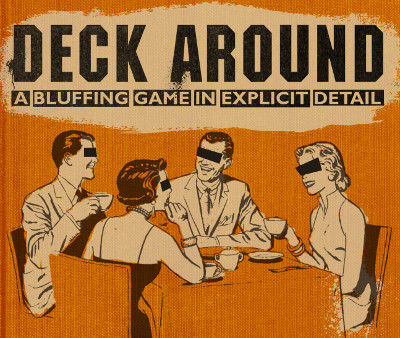
Deck Around

  • Published 2014Deck Around
  • # of players 3-20

One of the newer games out there, Deck Around takes Urban Dictionary and turns it into a card game (for those of you who don’t know what Urban Dictionary is… you probably don’t want to). The object of the game is to take a word or phrase on a card and make up a definition that you anonymously provide to the rest of the group, along with the real definition. Everyone then chooses what he/she thinks the correct definition is and if your definition is picked you win the points. This game is another great option for the dirty-minded who want to make some less-than-PG jokes. Enjoy learning all about what a Boston Blowfish is!

Mad Gab

  • Published 1996
  • # of players 2-12 (can be played in groups)

A wordplay game where you work in groups, Mad Gab takes a well-known phrase and changes itMad Grab to a string of unrelated words that, when said aloud, sound similar to the original phrase. The object is to read through the sentence until the team guesses the correct phrase. The entertainment comes in people almost saying the phrase, and the other team that knows the phrase laughing at the difficulty of it. Great for families and friends, you can either play with a timer of just go back and forth between teams trying to guess. You’ll have a great time either way.

Pit

  • Published 1903
  • # of players 3-8

A fast-paced and loud game, be careful when and where you decide to play Pit. Each player is dealt a hand of commodity cards (wheat, barley, etc.) and the objective is to trade resources until you corner the market of one resource. You can’t show the cards that you’re trading, so instead you try and trade with someone based on the number of cards. This normally devolves into everyone yelling the number of cards they want to trade (Trade 2! Trade 3! Trade 4!) and then when you have all of the cards you slam the middle of the table and call “corner on _______!” Your voice will be hoarse by the end of the game, but it’s definitely worth it.

Say Anything

  • Published 2008
  • # of players 3-8 (can be played in groups)

Say Anything focuses on a series of questions where each person writes down his or her answer and a judge decides which answer is best. To add to the competition, each player (or team) has chips that they can wager on any answer, including their own, and if the judge chooses that answer they will win points as well. You can play your tokens on multiple phrases, or you can bet it all on one. The game helps start a lot of dialogue and is a good way to start a party with a group of friends.

Set

  • Published 1988
  • # of players 1-20

One of my favorite games when I was a kid, Set is all about finding sets of 3 cards that either have the same or opposite characteristics (all the same shape or all different shapes, the same number of shapSet cardes or 1 2 and 3 of each shape, etc.) and then call “Set!” as soon as possible. After you find a set, new cards are added and the process continues. The person with the most sets by the end of the game wins. This game is one that makes you think and is great for younger kids to learn patterns and think quickly.

Taboo

  • Published 1989
  • # of players 4-10

One of the most well known games from the 90’s, Taboo is a group game all about hinting at keywords which the rest of your team has to guess. There are also Taboo words that you can’t say when you try and get other players to guess. The more keywords guessed, the more points you receive. A simple concept with a fun twist, Taboo is an entertaining game that is good at getting a larger group engaged in conversation.

The Game of Things…

  • Published 2002
  • # of players 4-15

The game Things… focuses on specific phrases such as Things… you shouldn’t put in your mouth, or questions similar to that (yes, a lot of them can be interpreted as dirty). One person acts as judge, and everyone else answers the phrase anonymously. Rather than voting on your favorite answer, the Judge chooses who they think answered the question. If he/she gets it right, they continue to guess until they get one wrong, and then the person to the judge’s left guesses until all phrases have been correctly guessed. This game is better the more players there are, so make sure you have a big group when you play.Things...cards

Uno

  • Published 1971
  • # of players 2-10

Another classic card game, Uno is one of those games that you will always enjoy playing even if you didn’t necessarily think of it first when you go to your game pile. A casual game that you can sit and play with any group, Uno is one of the universal party games that has been in households for years.

Utter Nonsense!

  • Published 2015
  • # of players 4-20

Utter Nonsense is a newer card game based on saying odd phrases in funny accents. Another “adult” game, Utter Nonsense has a silly humor about it that shows it doesn’t take itself too seriously. Similar to Cards Against Humanity, there is a different judge each round that draws an “accent” card to start off the round. Each other player then chooses one of his or her phrase cards and says the phrase in the accent that was played. These accents vary from normal ones like “Irish” to silly ones like “Valley Girl”. A bit hit or miss when it comes to the phrases, this is one of the games I encourage after you’ve had a few drinks (but it’s plenty of fun without drinks to).

Card Games and Card/Board Game Hybrids

games_cards

This week I’m going to be focusing on a very specific type of game for all of my posts; I’ll be writing about card games and how they fit into the board game world. Now when most people think of card games, their mind probably jumps to games like Magic: the Gathering, Duel Monsters, or maybe even Pokémon. These are great games that have their own place in the entertainment industry, but the card games I’m talking about are unique. These card games play and look like a board game in a lot of ways, and sometimes end up being thrown into the same category as “board game”. A lot of card games even take this a step further and add pieces and boards that add to the visual effects of the game, making the difference between a card game and a board game even murkier.

Duck of DoomFor the purpose of this conversation I will consider a card game a game that plays like a board game but the majority of action is based on playing the cards rather than moving on a board. A good example of this type of game is Munchkin, a D&D based card game which uses different monster, treasure, and event cards to progress the game and utilizes a board simply keep score (in the original version of the game there wasn’t even a board, you just kept score by hand). This type of game is focused on the cards and the effects they have on the game. In contrast, a game like Clue puts as much emphasis into moving around the board and going into specific rooms as it does the cards that you use to determine who the murderer is. For additional examples of these different types of games, check out the chart below:

Type of Game Game Description Game Examples
Board Game with Cards Focuses on moving across board rather than playing cards Clue, Ticket to Ride, Settlers of Catan
Card Game/Board Game Hybrid Uses a board to facilitate the game, but majority of focus is on playing cards Munchkin, Taboo, Trivial Pursuit
Card Game No board is used, solely focused on the cards Cards Against Humanity, Exploding Kittens, Uno

So now that we’ve established the types of game we’re talking about, what are the advantages of playing a card game versus a board game? Here are a few reasons these games are worth playing:

  • Less restriction to a particular area or movement: Board games generally have a defined space in which you can move and react with your character or piece (with certain exceptions). While there are advantages to having a set area to move about, an advantage to playing a card game is that there isn’t the same restriction. Whether this means that you have more freedom within the game itself to play your cards, or if it means you can all gather around and play on the floor, the flexibility of card games is a definite advantage to playing them.
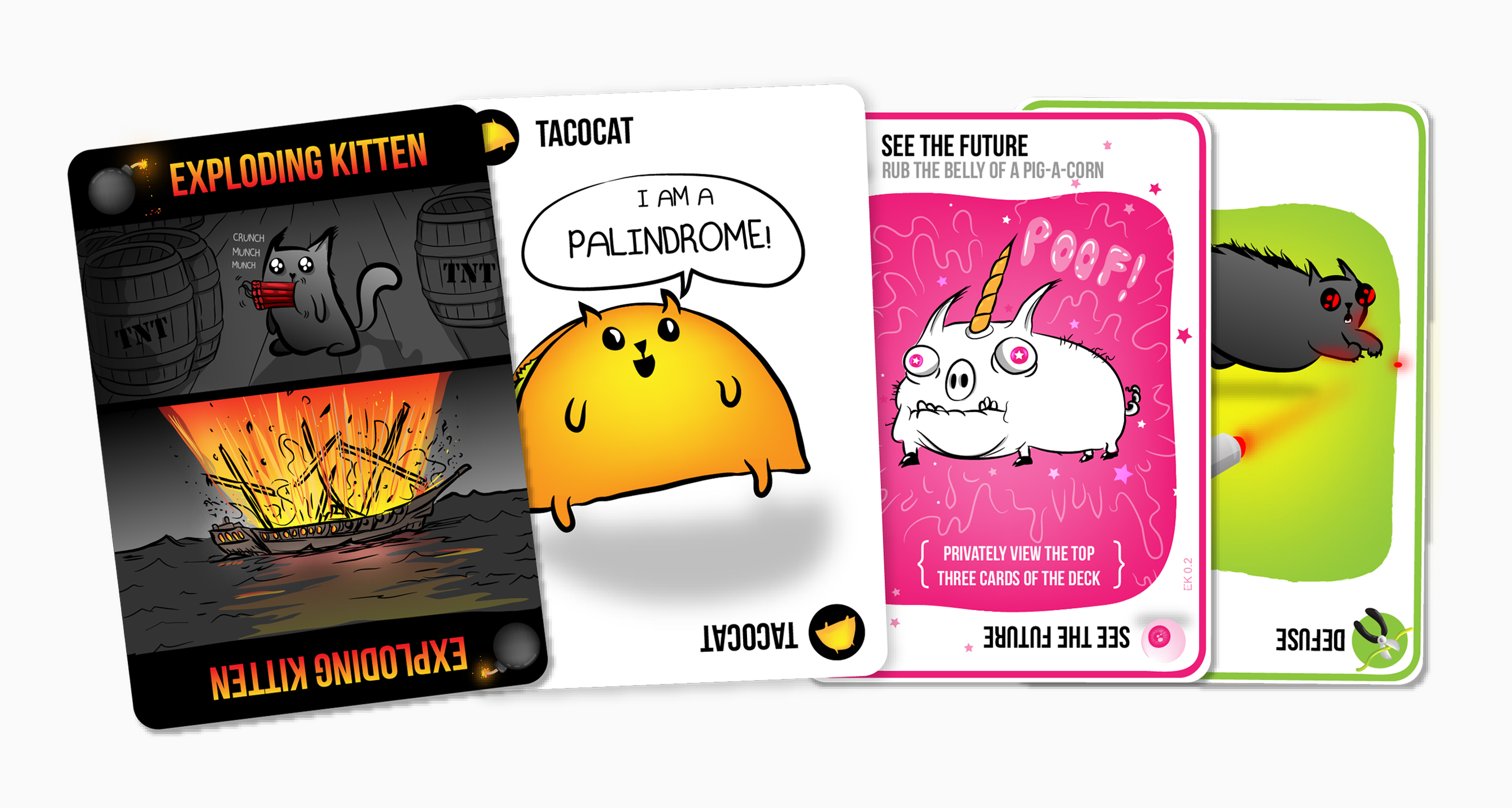
  • More opportunities for artwork and impressive images: Some of the most fun parts of a game are the aesthetics. Artwork is a huge portion of making a good game great, and card games have the ability to amplify this effect. Because there are so many different cards you can play in the average card game, artists have more of a chance to be creative and come up with great ideas. The best card games out there usually have cards with either beautiful or entertaining pictures on them.Exploding Kittens Cards
  • Similar style/feel of children’s games: When you look back at some of the games you played as a kid, it’s surprising how many of them involved a deck of cards. Games like Go Fish, War, and Cheat were common when my friends were stuck somewhere with nothing to entertain ourselves except a deck of cards. Playing a newer card game always brings me back to those times, and that excitement quickly translates into a fun experience for everyone.
  • Easy to Transport: Generally speaking, it is easier to pack a card game than it is to pack a board game. This is not always the case, but more often than not on road trips the card game is the one that will be easier to fit inside your suitcase. Bringing along some fun card games on trips can mean the difference between an entertaining evening of games and a few hours of trying to find something good on the hotel TV.

Plutomium Dragon

Ultimately card games and card/board game hybrids have many of the advantages of regular board games, with some added bonuses along the way. Similar to the board game industry, these types of games are only getting bigger and more common. Make sure to keep an eye out for some cool new card games next time you get a chance and I promise that you won’t be disappointed.


If you have any card games you are a big fan of or would like to know more about, comment below and tell me about them!