A
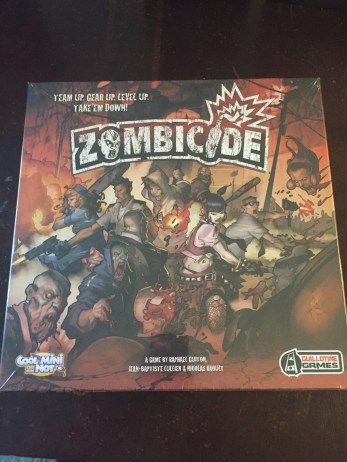
few months back I wrote an article about the internet revitalizing board games, where I listed Kickstarter as a major contributor to board games being revitalized over the past few years. That, coupled with my recent activity supporting some upcoming games on Kickstarter, has made me realize how big the tool has become for many game designers and enthusiasts alike. Being able to fund a game without the backing of a lar ge publishing company may not seem like the most effective way to get to where you want to go, but taking the game to the masses and hoping the concept draws enough support is certainly becoming more common. There have been over 9,000 board games that were created and published through a Kickstarter campaign, including significantly popular games such as Exploding Kittens, Zombicide, and Dark Souls- the Board Game. Still, there is a limitation to the effectiveness of Kickstarter, and it has to be noted that it is only one of the many avenues for finding new and exciting games on the market. Here is a list of pros and cons for using Kickstarter as a means to fund your board game ideas:


Pros:
- You have full control of the process- For people who want to have full control of the creative process, having a publishing company come in and make decisions on how to proceed would be very bittersweet. There are plenty of people who probably feel like the freedom to make decisions without other interested parties is a blessing. While it does also equate to more work, for someone who has dedicated time and effort to creating a game a little extra management isn’t going to ruin things.
- Gather a strong fan base before the game is created- The great thing about Kickstarter is that your game doesn’t even have to be published and it can still grow a huge following. Depending on the number of backers and the prizes each backer signed up for, you could already have a large number of people to send games to right away. In addition, Kickstarters thrive on social media expansion, so the more a Kickstarter is advertised the more likely it is to gain more traction once it is finished.
- Easier access to funds than through publisher- It’s difficult to make the case that a Kickstarter game is going to have significantly more funds than if the game was published by a game company (Exploding Kittens being the possible exception), but there certainly is an ease of access that helps Kickstarter campaigns become beneficial to game designers. Once a successful Kickstarter campaign is completed, funds are transferred to the game creator within a matter of weeks to begin the creation/distribution phase. Gaming publishers, especially larger ones, most likely would take a lot longer to go through the process of devoting resources to a game.
- Lower risk post-funding- Because of the clientele already built up with the campaign, a game that is funded through Kickstarter already has a good following and a group of customers lined up to purchase the game. Because of this, a game funded by Kickstarter has less risk than one that is published directly from other funding. That isn’t to say that there is no risk whatsoever, but after the funds come through the game has a group of supporters right away to take advantage of.
- Cost-effective alternative to self-publishing with personal funds- There are certainly some people out there who have the ability to use their own money to create a game themselves, but for those of us without that kind of funding available having an option to receive funding directly from the consumer cannot be understated. People who never thought they would have a chance to bring a board game to life have suddenly received that opportunity thanks to Kickstarter.


Cons:
- Goal must be met in order to receive funding- The biggest con about Kickstarter is that if you miss your goal, even by a dollar, you do not receive any of your funds. This means that you could spend countless hours promoting the game and making a working prototype, only to not receive funding because you weren’t able to generate enough backing.
- Start-up costs incurred for prototypes, incentives, etc.- Ultimately you can’t just start up a Kickstarter with an idea- you have to have put a lot of time and resources into it if you want it to succeed through a Kickstarter campaign. This is true if you were going to fund your game any other way, but it is enhanced when using Kickstarter because of the rewards programs usually created in a project. In order to incentivize backers to pledge higher amounts, a campaign will provide additional incentives to people who give greater amounts to the campaign. While this does benefit the designer by giving them a clientele to work with right away, it also means that the costs of the initial game creation can potentially be higher than in other situations.
- Less name recognition than if game is published- This isn’t always the case, and is only really applicable when compared to a game that is published by a larger gaming company, but Kickstarter funded games don’t always carry the same weight as with a major publishing company like Hasbro or Iello. It’s also more difficult to get a Kickstarter funded game into the hands of major stores, because the large companies have a significant investment in getting their games on shelves.
While there are risks involved in setting up a Kickstarter campaign for a board game, ultimately if done well and with a good idea it can be the perfect way to create something you never thought you could. Any aspiring board game designers out there should give a long thought towards using Kickstarter for your next game idea!


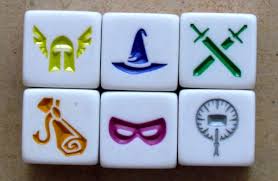 e and gain even stronger abilities. Once each player has a Hero card, the player who starts first rolls the white party dice to assemble his/her “party”. This party can consist of up to 6 different options, including five different classes (Champion, Wizard, Fighter, Rogue, and Cleric) and also a scroll dice which allows you to reroll any dice once. Once the party has been assembled, the player to the left of the one who rolled the party acts as the Dungeon Lord. The Dungeon Lord is in charge of rolling enemies for the party to fight.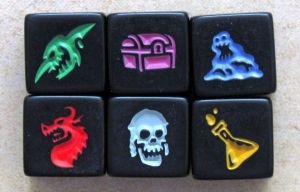
 re 3 dragon dice total. Once the third dragon is rolled, the party has to fight the dragon, which can only be defeated by sacrificing three different class dice. Once you defeat a dragon, you can an extra experience and can grab a treasure chip from the treasure chest.



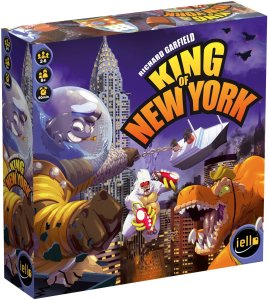

 to King of Tokyo (energy, heal, and attack) they added new sides to the dice for different effects. Instead of numbers 1-3, the dice now have destruction, celebrity, and Ouch! sides which provide different effects.

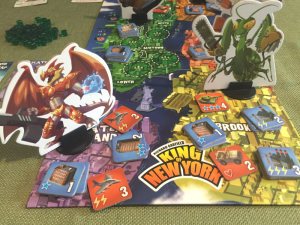 victory points). Once the building is destroyed, that building tile is flipped over to become an enemy unit. Enemy units attack you when you roll an Ouch! symbol, and can also be destroyed by destruction symbols for varying effects.
 someone is new to board gaming and better for more casual game nights. King of New York’s additions make the game more complex, which makes the game better for high-strategy groups and a more intense gaming experience. King of New York should not replace King of Tokyo in your collection, and in fact they both complement each other quite well. Because of this, I feel that King of New York deserves the same rating as King of Tokyo did: a fun, challenging, and engaging game with beautiful artwork that is great for your collection.


 dedicate your troops to an invasion is a crucial part of the game. You gain troops each turn, but after every turn the enemy has a chance at improving their ultimate weapon, so you can’t sit around and stockpile troops for too long. Sans Allies is also similar to the game
  trying to play the game. This meant that by the time I actually started playing the Limited War version of the game, I only had to check the rules a few times for my first play through. When I upgraded to Total War for my second play-through, I felt comfortable enough with the Limited War rules that I only checked the rules for Total War additions. Ultimately I’ve played through the game four times in total, and feel like I know pretty much everything I need to play the game moving forward.

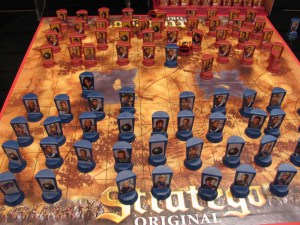 This game focuses more than any I know on pre-game setup. How you choose where to put your pieces effects the game almost more than your strategy for the game itself. Whether you put your flag as far away from the enemy troops as possible, try some form of misdirection, place the bombs near or far away from the flag, place your high powered players up front or use your weaker troops as shields, all of these ideas and more effect the game experience. Not only your choices, but your opponent’s choices and figuring out their strategy is crucial to success in this game. This doesn’t mean that the strategy stops when the game starts- memorizing your opponent’s pieces, understanding when sacrifices must be made, and adapting to new scenarios all become crucial as the game goes on. Being able to shift strategies and compensate for losses is one of the hardest things to do in a game, and Stratego takes this idea and runs with it.

 That’s why when my girlfriend got me The Resistance (The Dystopian Universe) for my birthday, I was immediately drawn to it. While the same level of story detail isn’t the same as in books, movies, or games, the theme adds a lot of character to a cool collaborative card-b
 eveal themselves to each other. This means that the spies know each other, but nobody from the resistance knows who is a spy and who’s not. The leader of the round then chooses a team of people from the whole group to go on the first mission (they can interrogate them beforehand) and the entire group votes on if they approve the choices. Once a team has been chosen or approved, they secretly play either a Success or Fail card. If anyone chooses a fail option, the mission fails and the spies get closer to victory. However, if nobody sabotages the mission, then it is a success and the Resistance moves closer to winning. A new leader is chosen, and the following rounds follow the same pattern until one team has three victories.
 without even going to the fifth round. Because the spies know each other, they can try and signal each other to choose if they are going to pass or fail for a mission, as well as supporting the other spies when they are chosen for a mission. You have to be much more attentive when you are not a spy because if you miss something you will most lik
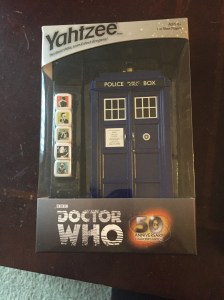 e of my passion for board games. The vast majority of my board game collection has come from my family, and since I played so many games with them when I was younger they have a good eye for what I like. They definitely knew what they were doing this time too, as they combined two of my favorite things in this gift. Yahtzee is a game that is pretty unpopular in some gaming circles, but it holds a special place in my heart because I remember playing it with my Gran whenever I visited my Dad’s family. Board games were always popular in the Dixon household, and Yahtzee was one of Gran’s favorites. In addition, Doctor Who is one of my favorite TV shows, so it has added value in comparison to the regular Yahtzee game.
 much about this game before, but from what I can tell The Resistance is a tabletop party game based around a dystopian universe where a group is trying to overcome a corrupt government. I love dystopian novels and themes, so that immediately stands out to me. Apparently the game relies on deception and misleading the other players, so it could be a Sheriff of Nottingham-esque game style. I’ll be sure to see what it’s like soon enough!
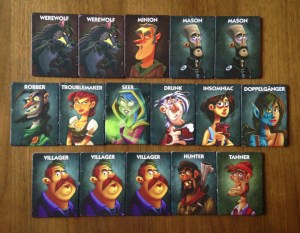
 Werewolf Game”, I’ve been hearing good things about this for a while so it wasn’t surprising when I unwrapped it. A fast-paced game (only allowing for ten minutes of play), the game apparently has an app that links to it and the board game is an expansion of that. Everyone playing gets a specific role and then… something happens. I honestly don’t know yet, but I know it’s a lot of fun and I have a group of friends lining up to play!
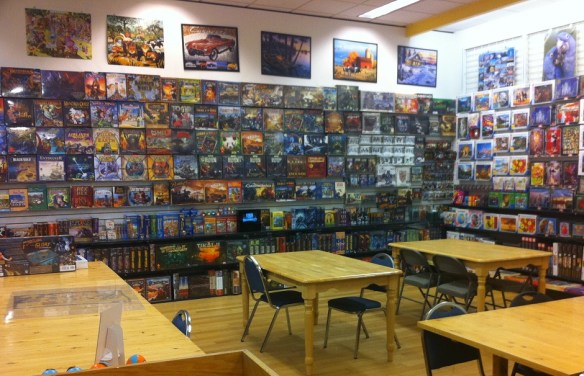
 board game store Games Unlimited in Pittsburgh and was immediately drawn to it. Unfortunately I had already decided on the game I wanted to buy, so in order to avoid spending too much money I didn’t get it. Luckily enough Mary was there, and she was kind enough to buy the game for me. Now, for those of you with a keen eye, you will notice that this game is a parody of Star Wars… that involves Sheep. Here is a basic description of the game: “You are a Sheep. You are a Defender in the Strategic Sheep Command. You have trained all of your career for this moment in history. You know how to defeat Wolf – Ewe’s The Force…” Another cooperative game with some obvious wit and humor, I can already tell that I’m going to have a ton of fun trying this one out.
 t it’s impossible to choose just one. Other than the most basic expansion which bumps up the number of players from 4 to 6, you also have the Seafarer’s Expansion, then Cities and Knights, Traders and Barbarians, etc. Then on top of that there are alternate games that are separate from the original. As one of the premier board games of our generation, it’s no surprise that Settlers has found ways to grow on its success through expansions. If you haven’t tried any of the cool additions to the game, I definitely recommend them, especially the Seafarer’s expansion.
 he 7 Wonders: Cities expansion, Leaders adds additional regular cards and also brings in 42 historical leader cards, which you play at the beginning of each age. It also adds another Wonder so that 8 people can play rather than 7. Overall if you like 7 Wonders, the Leaders expansion does a great job of adding additional layers to it and also giving an extra person a chance to play.
 curses, each card has its own personality and is a great way to make you laugh. While the expansion packs don’t create any major changes to the
 ad with King of New York went two separate ways: either they would make the game exactly like the original, or they would completely abandon the style and make a completely unimpressive game instead. Luckily enough neither of those things happened, and the game King of New York found a way to take the same principles of King of Tokyo and expand/revise them to make something different, but with the same feel as the original. Having both games in your board game collection is definitely worthwhile.
 , so when I tried out Europe I was surprised at the subtle yet powerful differences between the two. It took some time to get used to the different geography, but the addition of ferries and tunnels plus the additional railroad markers made the game subtly more challenging. While this version might not be able to replace the original for me, it was a lot of fun and I plan on adding it to my collection soon.
 The Boardwalk Games