I’ve been to a number of weddings over the past few months, and have realized that large outdoor games have become very popular for receptions and these types of outdoor events. With games like Corn Hole and Bocce Ball becoming commonplace in colleges and vacation spots as well, it got me thinking about the best games that can be played outdoors. There are large-scale versions of a number of board games, but there are also games that are created solely for outdoor play. Here is a list of my top 5 outdoor games from both of these categories:


Large-Size Games
- Yahtzee- Everyone’s favorite dice rolling game, there are multiple versions of outdoor Yahtzee, or “Yardzee”. The rules of the game are pretty much the same as the original game, but can be played out in a large space.
- Monopoly-Lifesize Monopoly where the players are the pieces is a pretty fun concept. This is less a game you can buy and bring to a party and more of something that can be found in certain parks and vacation spots.
- Jenga- While not necessarily an “outdoor game” giant Jenga is available at a number of bars/breweries, parties, and receptions. It is a popular game because of its simplicity and excitement, especially when someone loses!
- Chess/Checkers- Another popular vacation/park game, outdoor chess and/or checkers have become almost as popular as their regular-sized counterparts. With rules that everyone knows and heavy strategy, these outdoor games are perfect for all ages.
- Connect 4- This is one game that surprised me during my search for life-sized games. Connect 4, the chip placing game is available for relatively cheap in a large-scale version. This can be used for any number of events.


Original Outdoor Games
- Cornhole- By far the most popular of the outdoor gaming genre, cornhole can be found pretty much anywhere you go outdoors. The object of the game is to throw bean bags onto a slanted cornhole boards; throw them into the small hole in the board and you get extra points.
- Bocce Ball- Bocce ball has always been fairly popular in Europe, but it feels like it has only picked up in America recently. A game based on strategically throwing heavy balls towards a smaller ball (the “jack”) and the player with the bowls closest to the jack receives points
- Ladder Toss- In ladder toss, you throw two balls connected to a string (formerly called “bolas”) onto a ladder. You get points for which rung of the ladder you catch your bola on.
- Quoits (ring toss)- Ring toss is a well-known game in amusement parks, but quoits takes the same concept and makes it more portable for smaller gatherings. The board is set up specially to provide a greater score to certain rings, adding to the difficulty.
- Croquet- While it tends to take up more space than the other games on this list, Croquet is a very popular outdoor game based on smacking croquet balls through rings in a particular order. You also have the ability to knock other player’s balls out of the way as you move towards the finish.
All of these games, and more, are great additions to a party, wedding, or any other outdoor social event. While some of them will be more expensive and more popular than others, they are all fun games that deserve consideration for your next big even




 ge publishing company may not seem like the most effective way to get to where you want to go, but taking the game to the masses and hoping the concept draws enough support is certainly becoming more common. There have been over 9,000 board games that were created and published through a Kickstarter campaign, including significantly popular games such as


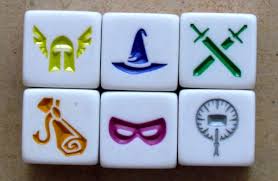 e and gain even stronger abilities. Once each player has a Hero card, the player who starts first rolls the white party dice to assemble his/her “party”. This party can consist of up to 6 different options, including five different classes (Champion, Wizard, Fighter, Rogue, and Cleric) and also a scroll dice which allows you to reroll any dice once. Once the party has been assembled, the player to the left of the one who rolled the party acts as the Dungeon Lord. The Dungeon Lord is in charge of rolling enemies for the party to fight.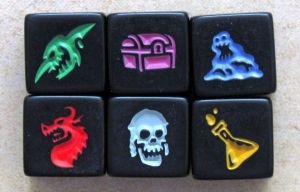
 re 3 dragon dice total. Once the third dragon is rolled, the party has to fight the dragon, which can only be defeated by sacrificing three different class dice. Once you defeat a dragon, you can an extra experience and can grab a treasure chip from the treasure chest.



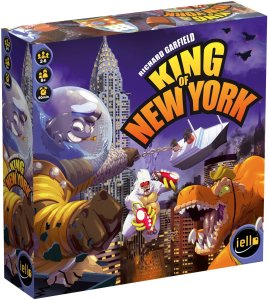

 to King of Tokyo (energy, heal, and attack) they added new sides to the dice for different effects. Instead of numbers 1-3, the dice now have destruction, celebrity, and Ouch! sides which provide different effects.

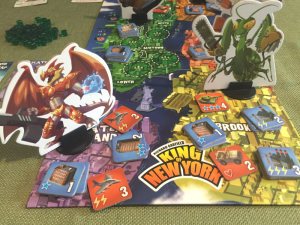 victory points). Once the building is destroyed, that building tile is flipped over to become an enemy unit. Enemy units attack you when you roll an Ouch! symbol, and can also be destroyed by destruction symbols for varying effects.
 someone is new to board gaming and better for more casual game nights. King of New York’s additions make the game more complex, which makes the game better for high-strategy groups and a more intense gaming experience. King of New York should not replace King of Tokyo in your collection, and in fact they both complement each other quite well. Because of this, I feel that King of New York deserves the same rating as King of Tokyo did: a fun, challenging, and engaging game with beautiful artwork that is great for your collection.


 dedicate your troops to an invasion is a crucial part of the game. You gain troops each turn, but after every turn the enemy has a chance at improving their ultimate weapon, so you can’t sit around and stockpile troops for too long. Sans Allies is also similar to the game
  trying to play the game. This meant that by the time I actually started playing the Limited War version of the game, I only had to check the rules a few times for my first play through. When I upgraded to Total War for my second play-through, I felt comfortable enough with the Limited War rules that I only checked the rules for Total War additions. Ultimately I’ve played through the game four times in total, and feel like I know pretty much everything I need to play the game moving forward.

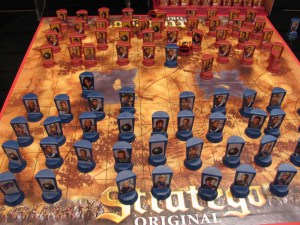 This game focuses more than any I know on pre-game setup. How you choose where to put your pieces effects the game almost more than your strategy for the game itself. Whether you put your flag as far away from the enemy troops as possible, try some form of misdirection, place the bombs near or far away from the flag, place your high powered players up front or use your weaker troops as shields, all of these ideas and more effect the game experience. Not only your choices, but your opponent’s choices and figuring out their strategy is crucial to success in this game. This doesn’t mean that the strategy stops when the game starts- memorizing your opponent’s pieces, understanding when sacrifices must be made, and adapting to new scenarios all become crucial as the game goes on. Being able to shift strategies and compensate for losses is one of the hardest things to do in a game, and Stratego takes this idea and runs with it.
 The Boardwalk Games