
There have been a lot of positive changes in the board game industry over the past few years. Unfortunately, one of the negative side effects of games becoming more intricate and advanced has been a higher price tag for a number of games. Game pieces have become more intricate, artwork more painstaking, and boards more elaborate as a whole, causing the cost of making the games to rise and consequently the price for the consumer to rise as well. A number of the games that I have mentioned on this blog are sold in the $50+ range, and while I enjoy investing my money in good games I also realize that people on a budget are looking for better options. In response to this, I have put together a list of my favorite games that you can buy for less!


Under $10- Games in this price range are almost always compact and straightforward card games. Card games have a significantly lower production cost than board games, and the straightforward play style means less space needed for rules or additional pieces.
1) Set
- Price on Amazon: $8.27
- Average Game Time: 30 minutes
- Number of Players: 1-20
2) Hanabi
- Price on Amazon: $9.77
- Average Game Time: 25 minutes
- Number of Players: 2-5
3) Pit
- Price on Amazon: $7.73
- Average Game Time: 45 minutes
- Number of Players: 3-8
4) Rook
- Price on Amazon: $5.50
- Average Game Time: 45 minutes
- Number of Players: 2-6
5) Loot
- Price on Amazon: $8.75
- Average Game Time: 20 minutes
- Number of Players: 2-8


Under $20- These games are slightly more complex than those in the $10 range, but still are primarily card-based and do not have a large amount of additional pieces. The artwork on these games is of good quality and the gameplay is in the easy to mid-range.
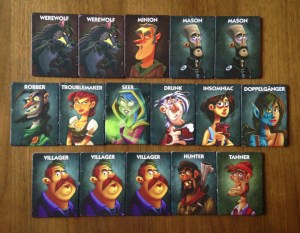
1) One Night Ultimate Werewolf
- Price on Amazon: $17.99
- Average Game Time: 10 minutes
- Number of Players: 3-10
2) The Resistance
- Price on Amazon: $13.00
- Average Game Time: 30 minutes
- Number of Players: 5-10
3) Sushi Go! Board Game
- Price on Amazon: $14.39
- Average Game Time: 15 minutes
- Number of Players: 2-5 players
4) Munchkin
- Price on Amazon: $18.89
- Average Game Time: 60 minutes
- Number of Players: 3-6
5) Codenames
- Price on Amazon: $14.39
- Average Game Time: 15 minutes
- Number of Players: 2-8


Under $30- If you’re willing to pay up to $30 on a game, you can really find some impressive gems. These games can be quite complex and have a number of different moving parts and pieces, but also keep the boards they use relatively compact in comparison to other games.
1) King of Tokyo
- Price on Amazon: $28.81
- Average Game Time: 30 minutes
- Number of Players: 2-6
2) Citadels
- Price on Amazon: $24.95
- Average Game Time: 40 minutes
- Number of Players: 2-8
3) Pandemic
- Price on Amazon: $24.99
- Average Game Time: 50 minutes
- Number of Players: 2-4
4) Qwirkle
- Price on Amazon: $24.70
- Average Game Time: 45 minutes
- Number of Players: 2-4
5) Carcassonne
- Price on Amazon: $22.39
- Average Game Time: 30 minutes
- Number of Players: 2-5
Overall, while playing some of the best games on the market will cost you more, you can find some great value on the cheaper side of the gaming industry too. If you keep an eye out for good deals and understand the level of investment you want to make on board games, you will soon find yourself with an impressive collection without breaking the bank.


 ge publishing company may not seem like the most effective way to get to where you want to go, but taking the game to the masses and hoping the concept draws enough support is certainly becoming more common. There have been over 9,000 board games that were created and published through a Kickstarter campaign, including significantly popular games such as


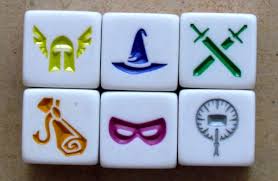 e and gain even stronger abilities. Once each player has a Hero card, the player who starts first rolls the white party dice to assemble his/her “party”. This party can consist of up to 6 different options, including five different classes (Champion, Wizard, Fighter, Rogue, and Cleric) and also a scroll dice which allows you to reroll any dice once. Once the party has been assembled, the player to the left of the one who rolled the party acts as the Dungeon Lord. The Dungeon Lord is in charge of rolling enemies for the party to fight.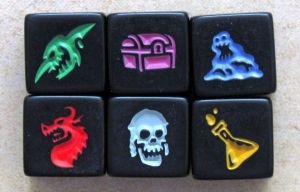
 re 3 dragon dice total. Once the third dragon is rolled, the party has to fight the dragon, which can only be defeated by sacrificing three different class dice. Once you defeat a dragon, you can an extra experience and can grab a treasure chip from the treasure chest.



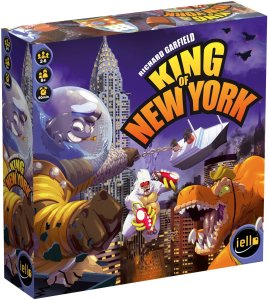

 to King of Tokyo (energy, heal, and attack) they added new sides to the dice for different effects. Instead of numbers 1-3, the dice now have destruction, celebrity, and Ouch! sides which provide different effects.

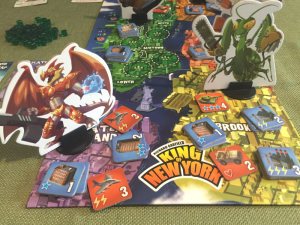 victory points). Once the building is destroyed, that building tile is flipped over to become an enemy unit. Enemy units attack you when you roll an Ouch! symbol, and can also be destroyed by destruction symbols for varying effects.
 someone is new to board gaming and better for more casual game nights. King of New York’s additions make the game more complex, which makes the game better for high-strategy groups and a more intense gaming experience. King of New York should not replace King of Tokyo in your collection, and in fact they both complement each other quite well. Because of this, I feel that King of New York deserves the same rating as King of Tokyo did: a fun, challenging, and engaging game with beautiful artwork that is great for your collection.


 dedicate your troops to an invasion is a crucial part of the game. You gain troops each turn, but after every turn the enemy has a chance at improving their ultimate weapon, so you can’t sit around and stockpile troops for too long. Sans Allies is also similar to the game
  trying to play the game. This meant that by the time I actually started playing the Limited War version of the game, I only had to check the rules a few times for my first play through. When I upgraded to Total War for my second play-through, I felt comfortable enough with the Limited War rules that I only checked the rules for Total War additions. Ultimately I’ve played through the game four times in total, and feel like I know pretty much everything I need to play the game moving forward.

 That’s why when my girlfriend got me The Resistance (The Dystopian Universe) for my birthday, I was immediately drawn to it. While the same level of story detail isn’t the same as in books, movies, or games, the theme adds a lot of character to a cool collaborative card-b
 eveal themselves to each other. This means that the spies know each other, but nobody from the resistance knows who is a spy and who’s not. The leader of the round then chooses a team of people from the whole group to go on the first mission (they can interrogate them beforehand) and the entire group votes on if they approve the choices. Once a team has been chosen or approved, they secretly play either a Success or Fail card. If anyone chooses a fail option, the mission fails and the spies get closer to victory. However, if nobody sabotages the mission, then it is a success and the Resistance moves closer to winning. A new leader is chosen, and the following rounds follow the same pattern until one team has three victories.
 without even going to the fifth round. Because the spies know each other, they can try and signal each other to choose if they are going to pass or fail for a mission, as well as supporting the other spies when they are chosen for a mission. You have to be much more attentive when you are not a spy because if you miss something you will most lik
 The Boardwalk Games